
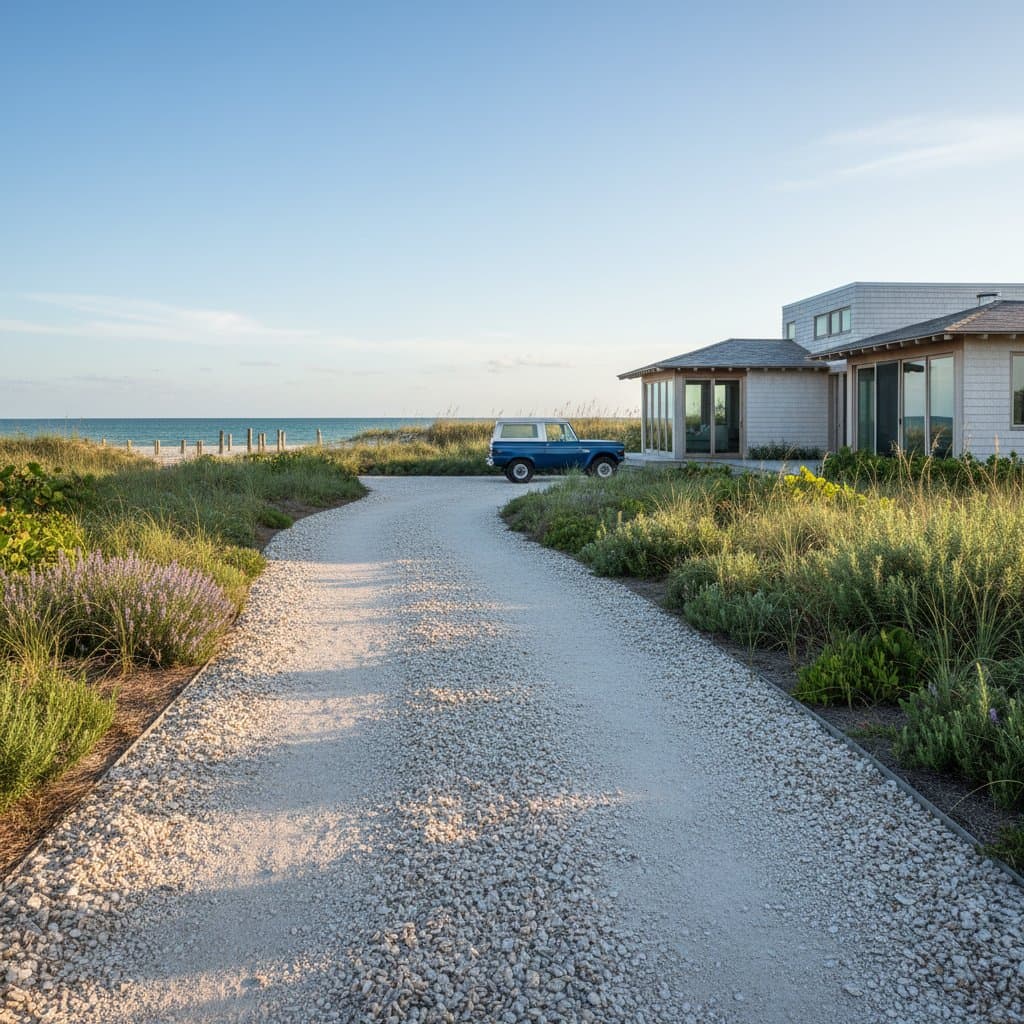
Why Oyster Shell Driveways Outperform Concrete in Coastal Settings
Picture arriving home from the beach with the gentle crunch of shells beneath your vehicle tires and a surface that catches the light. Oyster shell driveways deliver this appealing aesthetic while providing practical advantages for coastal properties. These driveways integrate seamlessly with the surrounding landscape, withstand salt corrosion, and promote environmental sustainability in manners that concrete cannot replicate.
This piece examines the reasons oyster shell driveways gain popularity in coastal regions. Readers gain insights into expenses, resilience, installation techniques, and upkeep requirements. The discussion also covers selecting between self-directed installation and professional services.
Essential insight: Oyster shell driveways generally range from $1,500 to $10,000 in cost, varying by dimensions and foundational materials. They serve as a minimal-upkeep, environmentally sound option to concrete, excelling in saline and sandy environments. For expert execution, obtain estimates from qualified specialists in coastal landscaping.
Factors Influencing Costs
The expense for an oyster shell driveway typically falls between $1,500 and $10,000, with an average of about $6,000 for a standard-sized installation. These figures hinge on the area covered, shell grade, and preparatory layers.
Primary elements of expenditure encompass:
- Shell materials: Crushed oyster shells range from $50 to $80 per cubic yard. Finer textures yield smoother driving surfaces and command premium rates.
- Site preparation: Foundations of gravel or limestone cost $1 to $3 per square foot, influenced by ground firmness.
- Workforce involvement: Expert labor contributes $2 to $5 per square foot, covering excavation, distribution, and compression.
- Boundaries and restraints: Options such as concrete edging or stone borders add $5 to $15 per linear foot, securing the shell perimeter.
- Ongoing care: Replenishing the upper layer occurs every several years at $300 to $600, scaled to the driveway's extent.
In contrast, concrete installations for comparable areas often total $4,000 to $12,000. Although concrete endures extended periods, it develops fissures in marine settings, positioning oyster shells as a viable and visually pleasing substitute.
Self-Directed Installation Versus Professional Expertise
Establishing an oyster shell driveway qualifies as a project requiring moderate proficiency, suitable for those adept at terrain leveling and earthwork.
Steps for self-directed installation:
- Delineate and quantify the space. Employ stakes and cord to define the driveway boundaries.
- Dig out 4 to 6 inches deep. Clear away surface soil and achieve a level base.
- Install the foundational layer. Distribute 3 inches of crushed gravel or limestone, followed by thorough compaction.
- Distribute the shells. Layer 2 to 3 inches of crushed oyster shells uniformly across the area.
- Compress and moisten. Apply a roller or vibrating compactor, then introduce light water to facilitate settling.
Self-directed efforts approximate $1.50 to $4 per square foot, contingent on shell procurement and tool leasing. Allocate 1 to 2 days for modest driveways.
Benefits of professional services:
Engaging a specialist in coastal surfacing guarantees optimal slope, water management, and densification. Professionals source superior shell mixtures and utilize advanced machinery for consistent application. Costs reach $5 to $10 per square foot, based on project intricacy.
Circumstances warranting professional assistance:
- Properties feature irregular topography or inadequate water flow.
- Long-term performance with reduced upkeep is the priority.
- A refined, consistent appearance is desired.
Upkeep Practices and Durability
Appropriate attention enables an oyster shell driveway to endure 10 to 20 years or beyond. The material compacts naturally through exposure to elements, forming a resilient outer layer that counters wear from wind and water.
Recommended upkeep procedures:
- Rake periodically to address depressions and ensure uniform thickness.
- Replenish every few years with new shells to preserve vibrancy and stability.
- Trim edges routinely to contain shells away from adjacent greenery.
- Flush with fresh water to remove salt deposits following severe weather events.
Concrete, however, fractures during temperature fluctuations or saline contact. Oyster shells accommodate minor ground movements, suiting the dynamic soils prevalent along shorelines.
Frequently Asked Questions
How do oyster shell driveways accommodate substantial vehicle weights?
A well-densified shell layer supports automobiles, light trucks, and recreational watercraft. For intensified loads, incorporate an augmented underlayer of fragmented stone to bolster capacity.
Is a permit required for installing an oyster shell driveway?
Certain seaside jurisdictions mandate approvals for driveway constructions or material alterations. Consult the local planning office prior to commencement to align with land-use policies and drainage standards.
Do oyster shells generate odors or draw insects?
Processed and pulverized shells eliminate residual organics. Reputable providers ensure products remain neutral in scent and unappealing to vermin.
What methods maintain the shells' white appearance?
Natural solar exposure fades shells gradually. Periodic additions of unweathered shells sustain the pristine, seaside aesthetic.
Are oyster shell driveways suitable for inland locations?
They function effectively in permeable soils. In regions with higher moisture, a deeper gravel foundation mitigates subsidence risks.
Steps to Transition to an Oyster Shell Driveway
Coastal residents seeking enhanced durability and ecological harmony find oyster shell driveways compelling. Begin by assessing your site's dimensions and soil conditions to estimate costs accurately. Source shells from sustainable suppliers to align with environmental values.
Next, decide on installation method based on your skills and time availability. Professionals offer warranties and design consultations for seamless integration with home exteriors. Regular maintenance ensures the surface remains functional and attractive for years.
Ultimately, this choice elevates property appeal while reducing long-term expenses compared to traditional concrete. Embrace the coastal essence with a driveway that endures the elements gracefully.