
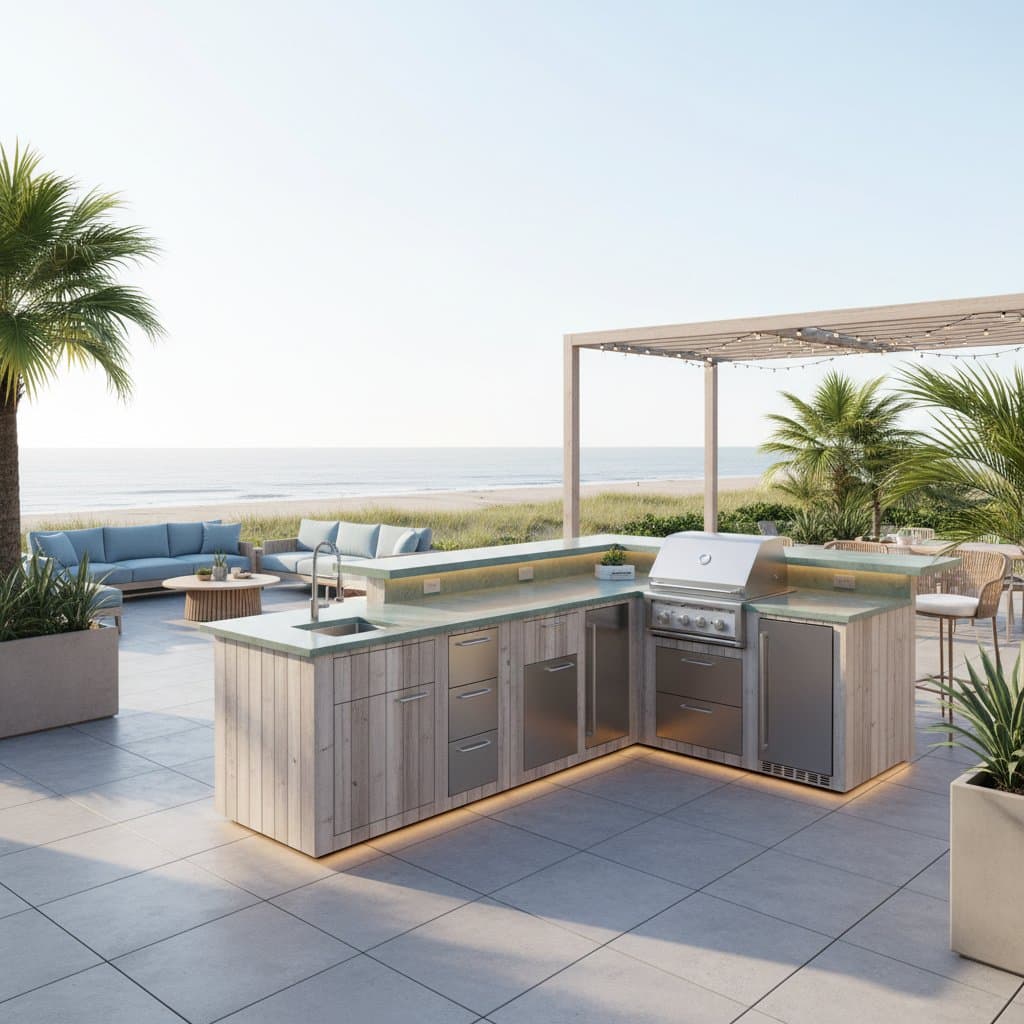
Snap-Together Modular Kitchens for Coastal Homes
Imagine grilling fresh seafood as the ocean breeze flows across your patio, with friends gathered nearby and all necessary tools within easy reach. A snap-together modular kitchen brings this vision to life with minimal effort. These systems provide the flexibility to construct an outdoor cooking area that complements a coastal lifestyle, eliminating the need for extensive building work. Options range from a simple grilling station to a full setup that includes preparation counters and refrigeration.
Snap-together modular kitchens for coastal homes generally cost between $3,500 and $15,000, based on selected materials and configuration. The typical homeowner invests approximately $8,000 in a mid-range arrangement featuring stainless steel cabinets, weatherproof counters, and a gas grill insert. One primary benefit lies in the ability to begin with a basic design and expand gradually. For professional installation, obtain estimates from highly rated contractors to evaluate choices and coverage options.
In This Article
- Cost factors
- Popular types and layouts
- DIY versus professional installation
- Key considerations for coastal homes
- Ways to save
- Maintenance and care tips
- Frequently asked questions
Cost Factors
A snap-together modular kitchen ranges in price from $3,500 to $15,000, while luxury versions with premium finishes and integrated appliances may exceed $20,000. Several elements determine the overall expense:
- Modules and size: The number of cabinets or appliance inserts directly affects the total. A basic two-module unit might total $4,000, whereas an L-shaped arrangement with six or more components could approach $12,000.
- Materials: Coastal settings require materials that resist corrosion. Marine-grade stainless steel or powder-coated aluminum exceeds the cost of painted steel yet offers superior longevity. Composite or porcelain countertops usually contribute $1,000 to $3,000 to the budget.
- Appliances: Integrated grills vary from $900 to $3,500. Additional items such as refrigerators, sinks, or pizza ovens increase the sum by $2,000 to $5,000.
- Land preparation: A flat surface of concrete or pavers proves essential. Allocate $500 to $2,000 for pouring a new slab or mending current decking.
- Permits and hookups: Connections for gas and electricity often necessitate expert work and municipal approvals. Plan for $300 to $1,000 in this area.
Average Cost Breakdown
| Feature | Low-End | Mid-Range | High-End |
|---|---|---|---|
| Grill module | $900 | $1,800 | $3,500 |
| Countertop | $600 | $1,200 | $3,000 |
| Cabinets | $1,000 | $2,500 | $5,000 |
| Appliances | $500 | $2,000 | $4,000 |
| Labor | $300 | $1,000 | $2,500 |
Popular Types and Layouts
Snap-together modular kitchens offer various configurations suited to compact patios or expansive coastal decks. Each option delivers specific benefits tailored to space constraints and culinary preferences.
Linear Layouts
These arrangements position all elements in a straight line, ideal for slender decks or modest courtyards. Begin with a grill, side burner, and counter module, then incorporate expansions as needed.
Best for: Compact patios or individuals who rent and anticipate relocation.
Pros: Efficient use of space and straightforward assembly.
Cons: Restricted preparation surface and storage capacity.
Photo: Cavan Images / Getty Images
L-Shaped Designs
An L-shaped configuration forms a dedicated zone for cooking and serving. It supplies ample workspace and separates preparation from cooking tasks.
Best for: Medium to large patios featuring a corner or open arrangement.
Pros: Superior workflow and abundant counter area.
Cons: Demands additional modules and a broader installation footprint.
Photo: Mint Images / Getty Images
Island Configurations
An island design centers the cooking station, frequently complemented by bar seating. This setup fosters interaction during meal preparation.
Best for: Social gatherings on open coastal decks.
Pros: Enhances conversation and communal activities.
Cons: Requires substantial space and potential subsurface electrical connections.
Photo: Johner Images / Getty Images
DIY Setup Versus Hiring a Professional
Most snap-together modular kitchens facilitate straightforward DIY assembly. Panels, cabinets, and appliances join via interlocking mechanisms or hidden fasteners. Individuals proficient with tools such as a drill, wrench, and level can complete a compact system in four to six hours.
DIY advantages:
- Reduce labor expenses by $500 to $1,500
- Adjust the layout without constraints
- Gain familiarity with module connections for subsequent additions
Professional installation advantages:
- Achieve precise alignment and reliable gas or electrical integrations
- Preserve warranty validity for embedded elements
- Receive guidance on optimal placement and drainage
For setups involving gas lines, substantial stone countertops, or integrated plumbing, engage a licensed contractor. Regulations in coastal areas enforce rigorous safety standards, which experts navigate effectively.
Key Considerations for Coastal Homes
Coastal environments present stunning vistas alongside demanding conditions. Salt-laden air, elevated humidity, and strong sunlight accelerate material degradation. Select components engineered to withstand these elements.
- Material durability: Opt for marine-grade stainless steel, stone composites, or powder-coated aluminum in cabinets. Steer clear of uncoated metals or absorbent woods that succumb to moisture.
- Corrosion resistance: Verify that fasteners and hinges feature protective coatings against rust.
- Drainage and leveling: Incorporate a gentle incline directing water away from the residence to avoid accumulation near the units.
- Shade and ventilation: Site the kitchen beneath a pergola or awning to shield from intense rays while promoting air circulation.
- Style continuity: Coordinate finishes with the home's facade. Neutral tones like white or sand tones harmonize with oceanic hues and natural stone accents.
Ways to Save on Your Modular Kitchen
Constructing an outdoor kitchen along the coast involves significant investment, yet targeted approaches control expenditures effectively.
- Start small: Initiate with a grill and single counter module, incorporating sinks or storage progressively.
- Purchase off-season: Acquire components post-summer, when discounts on outdoor appliances frequently appear.
- Mix materials: Pair stainless steel frameworks with composite surfaces rather than uniform stone for balanced durability and cost.
- Simplify hookups: Employ propane cylinders or electrical plug-ins to bypass expensive gas and power infrastructure.
- Handle finishing touches personally: Affix backsplash tiles or bar stools independently to minimize professional fees.
Maintenance and Care Tips
Exposure to salt and dampness can diminish the lifespan of an outdoor kitchen, but consistent care preserves its appeal over time.
- Rinse surfaces regularly: Apply fresh water promptly to eliminate salt deposits and inhibit corrosion.
- Cover appliances: Secure weather-resistant covers during idle periods, particularly ahead of inclement weather.
- Inspect fasteners: Secure any loosened bolts and substitute rusted parts yearly.
- Seal countertops: Reapply sealant to composite or stone surfaces annually to ward off discoloration.
- Lubricate hinges: Use silicone spray sparingly to ensure smooth operation of doors and drawers.
Frequently Asked Questions
How long does assembly take?
Homeowners typically complete a three-module kitchen in one afternoon. Expansive systems or those with utility integrations may extend to a full day.
Do modular kitchens need a foundation?
They demand a firm, even base like pavers, concrete, or composite decking. Direct placement on soil or turf proves unsuitable.
Can one relocate a modular kitchen?
Many designs accommodate disassembly and transport. Disconnect services, dismantle the modules, and reconstruct at the new site.
What materials endure best near the ocean?
Marine-grade stainless steel, powder-coated aluminum, and porcelain countertops outperform painted steel or raw wood in resisting salt-induced corrosion.
Maximizing Coastal Outdoor Cooking
With a snap-together modular kitchen installed, benefits extend well beyond utility. This addition promotes al fresco lifestyles, seamless hosting, and seaside meal preparation that enhances daily enjoyment.