
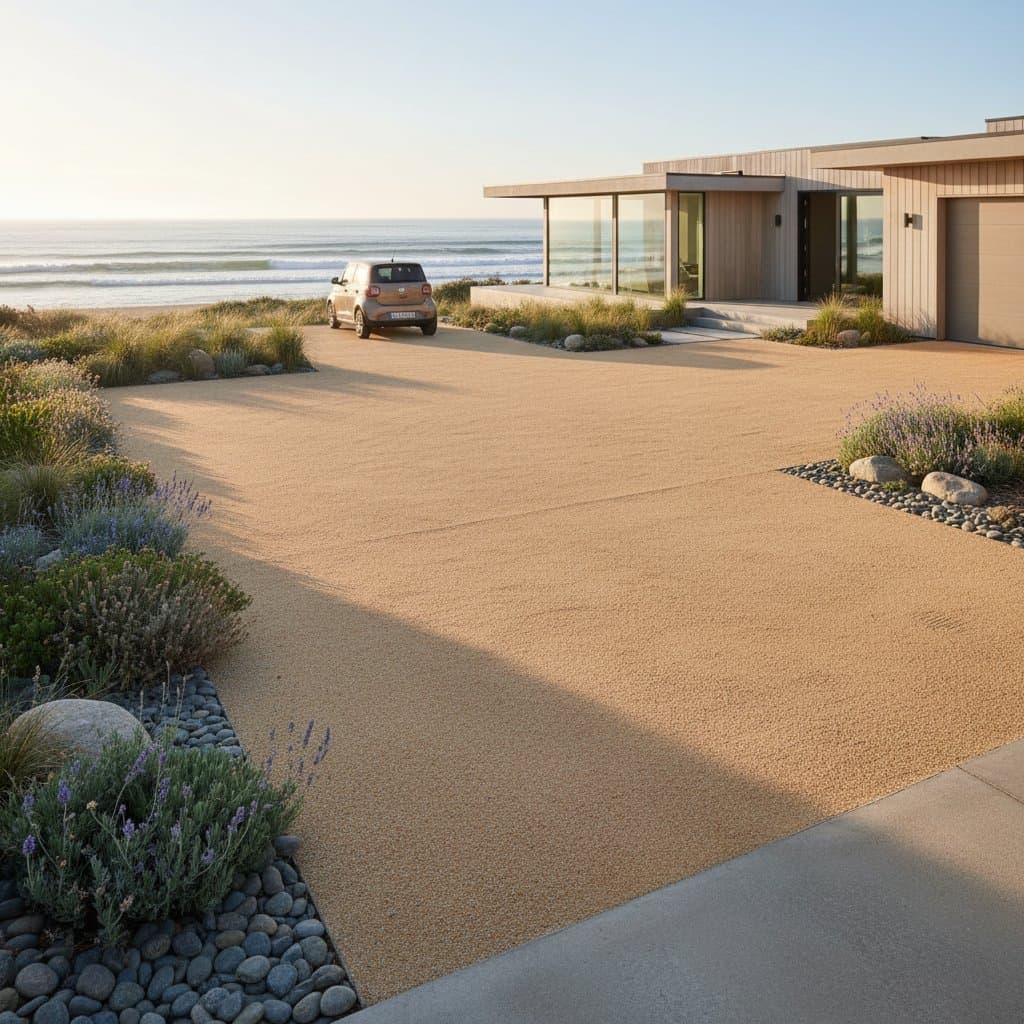
Decomposed Granite: Coastal Driveway Upgrade Over Concrete
Homeowners in coastal regions frequently encounter persistent issues with driveways. Salt-laden air accelerates corrosion on concrete surfaces, while persistent moisture contributes to cracking and deterioration. Constant upkeep becomes an ongoing burden. For those seeking a natural, low-maintenance alternative that harmonizes with beachside surroundings, decomposed granite presents an effective option. This guide details the application of decomposed granite over existing concrete, outlines the installation process, and provides strategies for achieving a resilient, permeable, and aesthetically pleasing driveway suited to coastal conditions.
Understanding Decomposed Granite Driveways
Decomposed granite, commonly abbreviated as DG, consists of finely crushed and weathered granite particles that form a gravel-like aggregate. When compacted, it yields a firm yet flexible surface with a rustic appearance ideal for coastal landscapes. In areas prone to salt exposure and high humidity, DG outperforms traditional materials by accommodating environmental stresses without rigid failure points.
Key Advantages of Decomposed Granite
- Permeability: Water infiltrates the surface easily, minimizing runoff and mitigating flood risks during intense rainfall events.
- Natural Aesthetic: Earthy hues integrate effortlessly with native plants, sandy soils, and ocean views.
- Low Maintenance: Proper installation minimizes the need for frequent repairs, unlike concrete that demands sealing and crack filling.
- Cost-Effective: Material and labor expenses generally fall below those for full concrete replacement or intricate paver systems.
- Eco-Friendly: As a naturally sourced product, DG promotes groundwater recharge and reflects less heat than impervious surfaces.
Challenges to Consider
Decomposed granite withstands typical wear but requires stabilization to prevent shifting under load. In high-traffic scenarios, uneven compaction can occur without reinforcement. For vehicular driveways, incorporate polymer-based binders or organic stabilizers during installation to enhance structural integrity and extend service life.
Preparing a Concrete Base for DG Installation
Overlaying decomposed granite on existing concrete conserves resources and accelerates the project timeline. Success hinges on meticulous surface preparation to promote bonding and facilitate drainage.
Step 1: Assess the Concrete Surface
Examine the driveway for structural weaknesses, including fissures wider than a quarter-inch, oil residues, and level inconsistencies. Pressure wash the area to eliminate contaminants, then allow it to dry completely. Patch cracks with a concrete filler and level depressions using a self-leveling compound for a stable foundation.
Step 2: Ensure Proper Drainage
Impervious concrete traps moisture underneath the DG layer, potentially causing instability. Slope the surface at a minimum of one percent away from structures, or drill 1/2-inch weep holes every two feet along perimeter edges. These measures direct water away and preserve the overlay's firmness.
Step 3: Apply a Binding Layer
Select a tacky adhesive primer formulated for aggregates, such as an acrylic-based bonding agent, and roll it evenly across the cleaned concrete. This layer secures the DG particles against slippage, particularly in humid coastal environments where moisture can weaken adhesion.
Step 4: Lay the Decomposed Granite
Distribute DG uniformly in lifts of 1.5 to 3 inches, sourcing stabilized variants with 5-10 percent fines for optimal compaction. Employ a vibrating plate compactor in multiple passes, starting from the edges and working inward, to achieve a density of at least 95 percent. For driveways accommodating vehicles, premix the DG with a dustless stabilizer like organic resin to bolster load-bearing capacity.
Step 5: Seal and Cure
After compaction, apply a fine water mist to activate the stabilizer, avoiding over-saturation that could displace material. Cure the surface for 24 to 48 hours under shade if temperatures exceed 80 degrees Fahrenheit. This process binds particles into a cohesive matrix that balances durability with water permeability.
Designing a Coastal-Style DG Driveway
Effective design aligns the driveway with the property's architectural elements and environmental context. Decomposed granite's versatility in texture and pigmentation allows for customized integrations that elevate overall landscape harmony.
Color Options
Available in natural palettes from warm golds and tans to cooler grays and subtle reds, DG adapts to diverse aesthetics. Opt for lighter variants in coastal settings to counter solar gain and pair with pale stucco facades or driftwood accents. Test samples under local lighting conditions to ensure long-term color fidelity against UV and salt degradation.
Edging and Borders
Define boundaries with corrosion-resistant materials such as galvanized steel strips or locally quarried stone. Install edging 4 to 6 inches deep, securing it with landscape pins every 18 inches. This containment prevents lateral migration while facilitating a fluid connection to adjacent pathways or planting beds.
Integrating with Landscaping
Incorporate DG into broader site designs by bordering it with salt-tolerant species like agave, lavender, or beach sunflower. These selections enhance biodiversity, conserve water through deep root systems, and create a low-water-use zone that complements the driveway's permeable nature.
Maintenance Tips for Long-Lasting Results
Decomposed granite demands less intervention than conventional pavements, yet proactive measures sustain its performance and appearance.
Routine Care
- Remove leaves, sand, and debris weekly using a stiff broom or leaf blower to inhibit weed growth and material degradation.
- Recompact softened sections by raking in fresh DG and applying the compactor after light watering.
- Monitor for depressions post-rainfall, filling them promptly with matching aggregate to restore evenness.
Seasonal Inspections
Conduct thorough reviews biannually, focusing on border integrity and slope erosion. In saline environments, hose down the surface quarterly to dissolve accumulated deposits. Address any binder breakdown by spot-applying a compatible rejuvenator.
Re-Sealing
Refresh the stabilizer every two to three years, or sooner in high-exposure areas, by broadcasting a thin layer of resin-infused DG and compacting it. Choose permeable sealants that maintain infiltration rates above 50 inches per hour to comply with environmental standards.
Environmental and Practical Benefits
Coastal locales enforce rigorous guidelines for stormwater management and habitat preservation. Decomposed granite aligns with these priorities by facilitating on-site water retention and minimizing ecological impacts.
Permeable Surface Advantages
Rainfall percolates through DG at rates exceeding 100 inches per hour, recharging aquifers and filtering pollutants before they reach waterways. This reduces sedimentation in coastal estuaries and supports compliance with low-impact development mandates.
Sustainability and Longevity
Retrofitting over intact concrete avoids landfill contributions from demolition debris and cuts embodied energy by up to 40 percent. The resulting hybrid system endures 15 to 20 years with care, outlasting untreated overlays in corrosive settings.
Cost Considerations
Budget for DG installation over concrete typically ranges from $4 to $8 per square foot, influenced by site specifics like slope grading and stabilizer type. Factor in professional assessment for complex preparations, and compare quotes from certified landscapers to optimize value.
Frequently Asked Questions
What is the best thickness for decomposed granite over concrete?
A depth of 1.5 to 3 inches suits most driveways, providing sufficient compaction for stability without excessive material use on a firm base.
Can decomposed granite handle vehicle traffic?
Stabilized DG supports standard passenger vehicles and light trucks when compacted to proper density. Avoid heavy commercial loads without additional reinforcement.
How does decomposed granite perform in coastal climates?
It excels by flexing with ground movement and draining excess moisture, resisting the freeze-thaw cycles and salt intrusion common in seaside areas.
Do I need to remove existing concrete before installing DG?
Preserve sound concrete slabs by overlaying directly, provided drainage modifications are implemented. Demolition becomes necessary only for slabs with more than 20 percent surface damage.
How often should decomposed granite be replenished?
Top up with 1/4-inch layers every three to five years, based on usage intensity and erosion patterns, to preserve uniformity.
Is decomposed granite slippery when wet?
Compacted and bound DG provides reliable footing, with friction coefficients comparable to gravel paths; loose applications pose greater risks.
What color works best for coastal homes?
Neutral tones like tan or light gray offer versatility, reflecting heat and blending with maritime palettes while withstanding atmospheric weathering.
Securing Driveway Durability in Coastal Settings
Decomposed granite over concrete delivers a resilient upgrade that withstands environmental rigors without extensive disruption. Through precise preparation and ongoing vigilance, homeowners gain a surface that enhances property value, conserves resources, and integrates seamlessly with coastal living. This approach yields enduring functionality and visual charm tailored to seaside demands.