
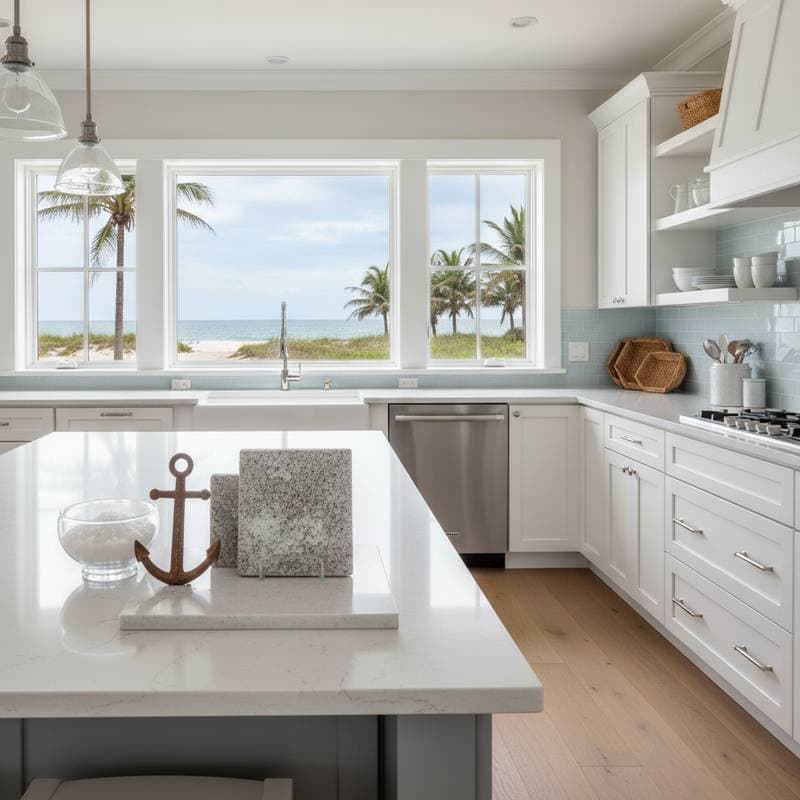
Why Quartz Countertops Outperform Granite in Salty Coastal Environments
7 Reasons Quartz Excels Over Granite for Salt-Resistant Coastal Kitchens
Coastal kitchen design presents unique challenges. Residents near the ocean face salt-laden air that infiltrates homes and accelerates wear on surfaces. This environment dulls metal fixtures, fades paint, and corrodes materials more rapidly than in inland settings. For countertops, selecting between granite and quartz requires careful consideration, as both offer beauty but differ in performance under salty conditions.
A countertop that endures without constant upkeep transforms the space. Increasing numbers of coastal homeowners select quartz for its superior adaptation to salt-heavy atmospheres. The following sections detail the primary advantages of quartz and provide guidance for integration into your home.
Durability and Resistance
1. Non-Porous Surface Shields Against Salt Intrusion
Quartz stands out due to its engineered non-porous composition. Granite contains microscopic pores that permit moisture absorption, including airborne salt particles. These elements infiltrate granite's micro-cracks, leading to gradual etching and surface degradation.
In contrast, quartz forms an impermeable barrier that repels liquids and salt deposits. Routine cleaning involves a simple wipe with a damp cloth, preserving the material's luster and smoothness.
Practical Advice: Maintain a supply of soft microfiber cloths for quick removal of salt residue, particularly after preparing seafood or following exposure to sea breezes through open windows.
[Image: Close-up of a quartz countertop in a bright coastal kitchen]
2. Reduced Maintenance Suited to Coastal Lifestyles
Granite demands periodic sealing to protect against moisture and stains, with more frequent applications necessary in humid, salty regions. Quartz eliminates this requirement entirely, reducing long-term expenses and effort.
Individuals who value simplicity find quartz particularly appealing. Basic cleaning routines suffice to keep the surface vibrant, allowing more time for appreciating coastal surroundings rather than performing upkeep.
Aesthetic Appeal and Design Versatility
3. Colors and Patterns Aligned with Coastal Themes
Quartz production enables a broad spectrum of hues tailored to seaside aesthetics. Options include gentle whites, neutral beiges, and delicate veining that emulate natural stone with reliable uniformity.
Granite's palette depends on natural occurrences, resulting in unpredictable variations between slabs. Quartz provides predictability, facilitating the achievement of airy, light-filled coastal designs.
Practical Advice: Combine neutral quartz surfaces with sea-inspired glass tiles or cabinets in warm, wood-like tones to evoke a serene beach atmosphere.
[Image: Modern coastal kitchen with white quartz countertops and ocean-blue backsplash]
4. Consistent Appearance for Seamless Open Layouts
Open-plan coastal residences often integrate kitchens with adjacent living areas. Quartz delivers a seamless, uniform finish across expansive installations, enhancing overall harmony.
Granite's inherent variations create visual interest but risk inconsistency when adjoining multiple pieces. With quartz, focal points such as lighting fixtures or panoramic views remain prominent without competing patterns.
Functionality and Endurance
5. Enhanced Defense Against Stains and Corrosive Effects
Beyond surface dulling, salt air reacts with components in natural stone, promoting slow deterioration. Quartz, composed of crushed stone bound by resin, exhibits remarkable chemical stability.
Substances like citrus juices, vinegar, or brines from marine foods pose minimal risk of penetration or etching. Granite may show subtle discoloration as sealants degrade, whereas quartz retains its initial polish through everyday use.
6. Structural Integrity Amid Humidity Fluctuations
High humidity levels near the coast induce expansion and contraction in organic materials, potentially causing fissures or seam instability. Quartz's formulation ensures dimensional stability across varying moisture conditions.
Although granite possesses considerable strength, it proves somewhat susceptible to such environmental stresses. Prolonged exposure might result in edge chipping or joint separation, while quartz maintains its form and finish indefinitely.
Economic Considerations and Sustained Benefits
7. Strategic Choice for Enduring Coastal Value
Upfront pricing for quartz aligns closely with premium granite selections, yet lifetime savings accumulate through avoided sealing, supplies, and repairs. The material's persistent appeal also bolsters home resale potential.
For those committed to seaside living, quartz merges practicality with elegance, yielding returns that extend beyond aesthetics.
Practical Advice: Budget comparably to superior granite options, but anticipate substantial reductions in ongoing maintenance expenditures.
[Image: Coastal kitchen featuring quartz countertops and stainless-steel appliances]
Strategies for Selecting Coastal Countertops
- Opt for lighter or mid-tone shades to maximize light reflection and minimize thermal buildup.
- Employ pH-neutral cleaners to safeguard the surface integrity.
- Steer clear of harsh abrasives that could compromise the finish.
- Prioritize quartz in prominent zones, such as central islands or sink vicinities, when blending materials.
Common Questions on Coastal Countertop Choices
Does quartz offer superior resistance to salt compared to granite?
Quartz's non-porous nature effectively bars salt and moisture penetration, unlike granite's porous structure that permits gradual absorption.
Will quartz fade under intense coastal sunlight?
High-quality quartz withstands discoloration from natural light exposure. Select variants rated for UV stability when installing near expansive windows.
Is it safe to place hot cookware directly on quartz?
Use protective trivets or mats for hot items. Quartz tolerates moderate temperatures but risks thermal damage from excessive heat.
Maximizing the Appeal of Your Seaside Kitchen
Integrating quartz countertops equips your coastal kitchen to withstand environmental rigors while enhancing daily functionality. This selection not only simplifies care but also amplifies the serene beauty of ocean proximity. Consider consulting local experts to customize options that align with your specific shoreline conditions.