
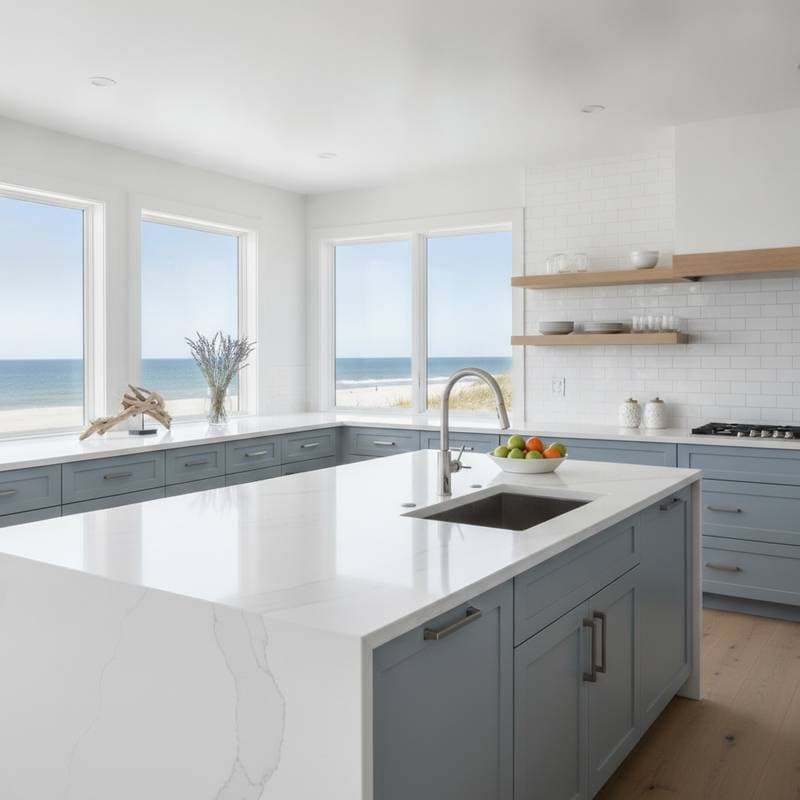
Why Quartz Outperforms Granite for Beach House Countertops
Quartz has become the preferred surface for coastal kitchen and bath remodels. It offers a nonporous structure that withstands salt air and humidity while requiring minimal upkeep. Homeowners gain consistent color options and reliable performance that natural stone often fails to deliver in marine environments.
This guide examines cost ranges, performance differences, and practical selection steps. Readers will find installation considerations, budget strategies, and care routines suited to beach properties.
Key takeaway: Installed quartz surfaces typically range from 2000 to 5500 dollars. Granite installations often fall between 2500 and 6500 dollars. Quartz provides stain resistance and uniform appearance without annual sealing.
Cost Factors
Material price depends on thickness, color rarity, and edge profile. Prefabricated quartz slabs in standard coastal shades remain the most affordable option. Custom patterns and thicker profiles increase both material and labor expenses.
Granite pricing varies more widely because each slab differs. Rare veining or imported blocks command premiums. Quartz offers more predictable budgeting since manufacturers control production.
Material Comparisons
Quartz
Quartz consists of crushed stone bound with resin and pigment. The resulting surface contains no pores, which prevents salt and moisture intrusion.
Best suited for: owners seeking minimal maintenance and uniform appearance.
Advantages:
- Resists staining and bacterial growth
- Requires no periodic sealing
- Offers repeatable colors across multiple slabs
Limitations:
- Loses color stability under constant direct sunlight
- Tolerates less heat than natural granite
Granite
Granite forms through natural cooling of magma and arrives at job sites as quarried slabs. Each piece displays unique mineral patterns.
Best suited for: traditional designs that emphasize organic variation.
Advantages:
- Withstands high temperatures without damage
- Provides distinctive natural veining
Limitations:
- Absorbs liquids unless sealed yearly
- Etches when exposed to citrus or vinegar
In salt air conditions, unsealed granite develops pitting and discoloration. Quartz eliminates these risks through its manufactured density.
Design and Style Options
Quartz manufacturers produce finishes ranging from polished to honed. Honed surfaces reduce glare in bright coastal rooms. Subtle gray and white tones complement ocean views without overwhelming natural light.
Edge profiles such as eased or bullnose create clean lines that suit modern beach architecture. Larger islands benefit from book-matched patterns that maintain visual continuity.
Professional Installation Process
Quartz slabs weigh more than twenty pounds per square foot. Accurate templating and seam placement require specialized equipment. Most projects benefit from fabricators experienced with coastal homes.
Professional service includes:
- Structural assessment of existing cabinets
- Precise sink and appliance cutouts
- Warranty coverage for both material and workmanship
Attempting installation without proper tools risks cracking or uneven support. Obtain three written estimates that detail seam locations and edge treatments.
Budget Strategies
Select mid-range colors produced in volume to control material cost. Combine quartz on primary surfaces with durable laminate on secondary areas. Schedule work during contractor off-seasons when labor rates may decrease.
Verify that the chosen fabricator offers remnant programs for smaller projects such as vanities.
Maintenance Routines
Daily cleaning requires only warm water and a pH-neutral soap. Avoid abrasive pads that can dull the finish over time.
Protect against thermal shock by using trivets under hot cookware. Wipe salt residue from windows or doors promptly to prevent surface buildup.
Common Questions
Can quartz serve in outdoor beach kitchens?
Prolonged ultraviolet exposure may alter certain resins. Specify UV-stabilized formulations or consider porcelain alternatives for exterior use.
Does quartz improve resale value in coastal markets?
Buyers recognize the low-maintenance qualities and modern appearance. Properties featuring quartz often sell faster than those with unsealed natural stone.
Is quartz considered sustainable?
Production utilizes mining byproducts and sometimes incorporates recycled content, reducing overall quarry impact compared with full granite extraction.
How long does quartz last near the ocean?
Properly installed quartz surfaces remain serviceable for decades when protected from extreme heat and direct sun.
Selecting Your Quartz Surfaces
Review physical samples under the specific lighting conditions of the beach house. Engage a local fabricator early to confirm measurements and lead times. The resulting installation delivers lasting performance that matches the relaxed demands of coastal living.