
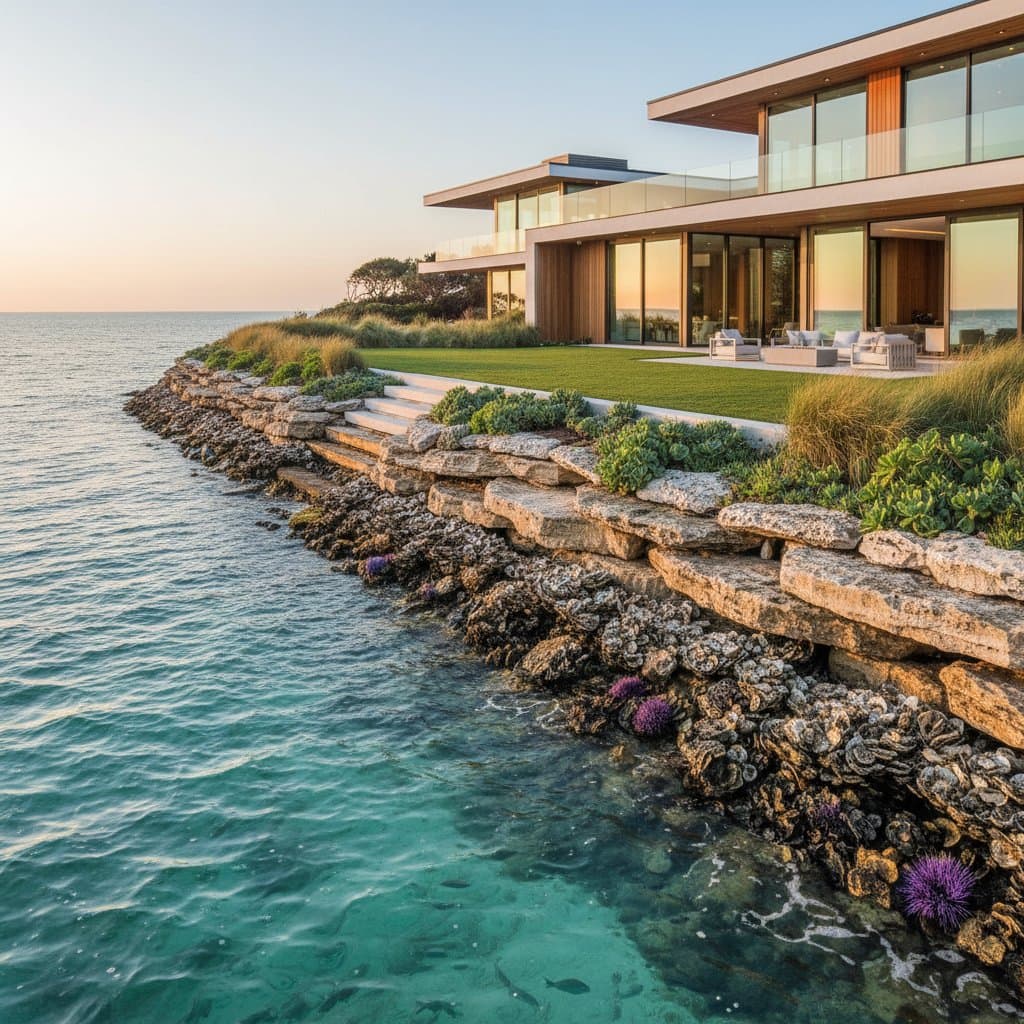
Why Luxury Homes Swap Concrete for Living Seawalls
Waterfront living attracts homeowners with its rhythmic waves, fresh sea air, and expansive views. Rising sea levels and intensifying storms, however, expose the limitations of conventional concrete seawalls. In coastal areas such as San Diego, luxury properties increasingly adopt living seawalls, which offer superior protection through sustainable design.
These structures integrate engineering with natural elements to safeguard shorelines while promoting biodiversity. They deliver aesthetic enhancements, operational efficiency, and ecological advantages that align with contemporary coastal priorities.
Key Advantages:
- Effective defense against erosion and storm surges
- Promotion of marine species including oysters, mussels, and algae
- Elevation of waterfront visuals through natural integration
- Reduction in ongoing maintenance expenses relative to concrete alternatives
- Boost to property valuation and environmental reputation
Defining a Living Seawall
A living seawall represents an innovative coastal barrier that merges structural integrity with biological support. Unlike uniform concrete surfaces, these systems incorporate textured elements such as ridged panels or modular units resembling rocky outcrops or reef formations. They moderate wave impact while fostering habitats for aquatic life.
In essence, a living seawall functions as a fortified barrier that nurtures rather than repels the surrounding ecosystem.
Essential Elements
- Textured Panels: Engineered with grooves, recesses, and perforations to replicate natural coastal features
- Colonizing Species: Native organisms like oysters, barnacles, and kelp attach and fortify the surface
- Fluid Dynamics: Permeable features permit water circulation, minimizing hydraulic forces
- Eco-Materials: Sourced from recycled aggregates, natural stone, or biodegradable polymers
Photo: A contemporary San Diego residence showcasing a living seawall adorned with oyster aggregations.
Reasons Luxury Properties Adopt Living Seawalls
Affluent homeowners view environmental responsibility as integral to their residences. Living seawalls embody this ethos, harmonizing protection with ecological enhancement in upscale coastal settings.
1. Superior Erosion Management
Concrete barriers often redirect wave forces, accelerating scour at their foundations and adjacent areas. Living seawalls, by contrast, capture and diffuse energy through their irregular profiles. As attached biota develop, they contribute additional resilience, forming a self-reinforcing shield against progressive shoreline loss.
2. Enhanced Visual Harmony
Standard seawalls project a stark, utilitarian presence. Living versions introduce organic textures, vibrant hues from marine growth, and subtle underwater motion, transforming the edge into an integrated landscape feature. This elevates daily enjoyment and market appeal for high-end estates.
3. Commitment to Ecological Balance
Discerning purchasers seek residences that advance conservation. A living seawall signals proactive stewardship, yielding benefits like purified waters, robust habitats, and enriched local flora and fauna.
Practical Advice: Select designs incorporating oyster habitats; each mature oyster processes up to 50 gallons of water daily, curbing nutrient overload and algal proliferation.
4. Economic Advantages Over Time
Traditional seawalls demand regular interventions for fractures, degradation, and base undermining. Although living seawalls entail a modest initial premium, their biological augmentation curtails repair needs, yielding savings across decades.
| Seawall Type | Upfront Investment | Upkeep Level | Expected Durability | Ecological Impact |
|---|---|---|---|---|
| Concrete | Moderate | Elevated | 20-30 years | Minimal |
| Living | Elevated | Reduced | 30-50 years | Substantial |
Photo: Comparative view of a plain concrete seawall beside one alive with attached marine communities.
Mechanics of Living Seawalls
These systems leverage biological processes to establish resilient micro-environments. Organisms adhere, proliferate, and consolidate the framework, optimizing both defense and habitat functions.
Installation Sequence
- Site Evaluation: Specialists analyze tidal patterns, substrate composition, and indigenous biota.
- Custom Design: Fabricate units with intentional textures and openings to invite settlement.
- Deployment: Secure modules to the coastal margin or retrofit onto legacy structures.
- Biological Establishment: Sessile species gradually populate the surfaces.
- Adaptive Fortification: Expanding growth layers deposit calcium and organic matter, bolstering integrity.
Photo: Detailed image of barnacles and oysters encrusting a living seawall module.
Contributions of Oysters and Reef Structures
Oysters excel as bio-filtrators, with individuals capable of processing substantial water volumes to extract sediments and toxins. Within living seawalls, oyster clusters form attenuating layers that temper incoming surges, mitigating erosive forces.
These formations also provide refuge for juvenile fish, crustaceans, and invertebrates, cultivating a productive nearshore zone. Homeowners thus gain a protective asset that simultaneously revitalizes the adjacent marine realm.
Varied Configurations for Living Seawalls
Site-specific adaptations ensure optimal performance across diverse conditions. Consider these established variants:
- Integrated Systems: Fuse core concrete stability with overlaid ecological modules.
- Intertidal Reservoirs: Incorporate shallow basins that hold moisture at ebb tide, sustaining diverse life.
- Shell-Based Attractors: Employ mesh enclosures of reclaimed shells to seed oyster populations.
- Sloped Armors: Layer permeable stones on inclines to dissipate energy gradually.
Practical Advice: For legacy installations, hybrid retrofits minimize disruption while introducing green elements.
Potential Hurdles and Planning Essentials
Implementation requires careful evaluation to maximize efficacy.
- Regulatory Compliance: Secure approvals from coastal authorities for alterations.
- Environmental Fit: Account for salinity levels, sediment dynamics, and exposure intensity.
- Budget Allocation: Prepare for elevated startup expenditures offset by enduring gains.
- Ongoing Oversight: Schedule inspections to sustain biological vitality.
These considerations, when addressed, position living seawalls as a strategic upgrade for discerning properties.
Initiating a Living Seawall Installation
To transition from concrete, engage experts for a tailored shoreline analysis. Specialists in sustainable defenses provide scalable solutions suited to individual estates.
Proceed as follows:
- Engage Regional Experts: Contact certified marine engineers.
- Examine Options: Assess material variants and modular configurations.
- Navigate Approvals: File for ecological and structural clearances.
- Time the Work: Align with favorable weather windows.
- Track Progress: Conduct yearly evaluations of structural and biotic health.
Photo: Professionals affixing modular units to a secluded shoreline estate.
Realizing the Full Potential of Your Coastal Edge
A living seawall transcends mere fortification; it embodies forward-thinking stewardship. Envision mornings with clearer waters teeming below your terrace, where natural processes fortify your domain against encroaching seas.
This choice safeguards assets while nurturing enduring coastal health, ensuring legacy for future inhabitants.