
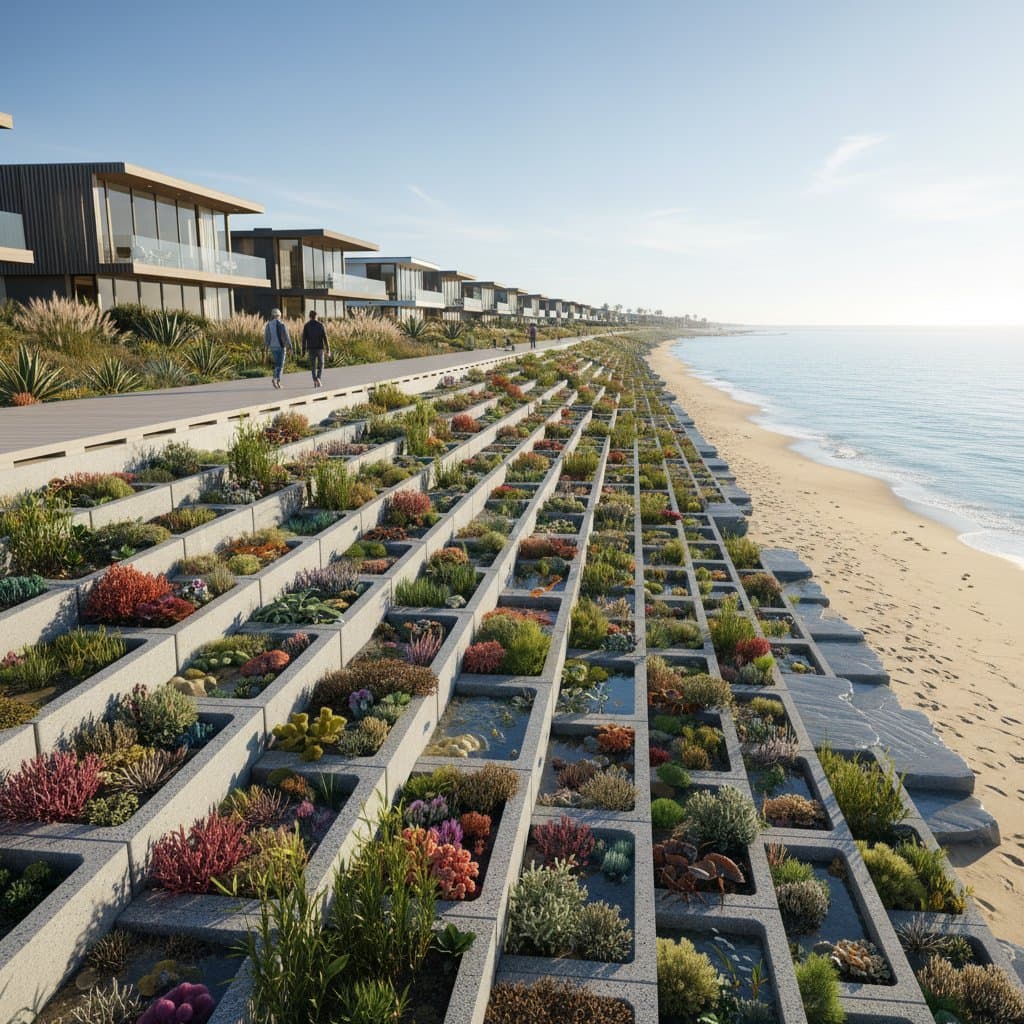
Why Living Seawalls Outperform Concrete for Beach Protection
Picture a coastal walkway where waves gently meet a surface teeming with barnacles, oysters, and seagrass beds. The atmosphere carries a sense of vitality, the water appears pristine, and the shoreline maintains a natural equilibrium. Living seawalls deliver this scenario. Rather than imposing gray concrete that repels waves and hastens erosion, these innovative structures merge structural integrity with biological elements to defend beaches and nurture ocean life.
This article details the advantages of living seawalls over traditional concrete barriers for shoreline defense. Readers gain insights into installation costs, available designs, ecological advantages, and practical considerations for implementation. Although initial expenses range from $300 to $1,200 per linear foot, the enduring benefits in durability, environmental health, and visual appeal position them as a prudent investment for coastal property owners and municipalities. For expert guidance, consult qualified specialists in sustainable erosion management.
In this Article
- Cost Factors
- Types and Options
- DIY Versus Professional Installation
- Strategies to Reduce Expenses
- Frequently Asked Questions
Why Living Seawalls Excel in Performance
Conventional concrete seawalls redirect wave energy toward the sea, leading to intensified scouring at their foundations and accelerated beach degradation. This process gradually forms precarious, eroded slopes devoid of ecological significance. In contrast, living seawalls capture and diffuse wave forces through irregular textures and root systems. Consequently, shorelines achieve stability and facilitate natural sediment accumulation.
These designs foster habitat variety as well. Recesses, perforations, and protrusions offer refuge and foraging areas for juvenile fish, crustaceans, and mollusks. As oysters and barnacles establish colonies, they purify surrounding waters and boost transparency. Such symbiotic interactions fortify the installation and cultivate a thriving coastal environment.
Moreover, living seawalls enhance visual harmony. Architects can shape them to echo nearby rock outcrops or incorporate intertidal pools that draw diverse species. Property owners along beaches thus enjoy a dynamic, organic facade instead of an utilitarian one.
Cost Factors
The price of a living seawall varies based on several elements, including design complexity, site conditions, and material selections. Basic modular units start at $300 per linear foot, while intricate hybrid systems with extensive vegetation may reach $1,200 per linear foot. Labor constitutes 40 to 60 percent of total costs, influenced by accessibility and regulatory approvals.
Site-specific challenges, such as rocky substrates or high wave exposure, increase expenses through additional engineering. Material choices also impact budgets; locally sourced aggregates reduce transportation fees, whereas imported eco-concrete elevates outlays. Long-term projections reveal savings, as these structures demand less frequent repairs than concrete alternatives, which often succumb to undermining within 10 to 15 years.
Property owners should obtain multiple estimates to compare options. Factor in potential rebates from environmental programs, which can offset 20 to 50 percent of upfront investments for qualifying projects.
Types and Options
Modular Living Seawalls
Modular configurations employ pre-cast panels featuring undulating profiles, niches, and shelves that replicate intertidal zones. Installation proceeds swiftly, with panels interlocking to conform to irregular contours.
Ideal Applications: Residential shorelines and compact harbor facilities.
Advantages: Rapid deployment, tailored aesthetics, promotion of species diversity.
Disadvantages: Precise positioning essential to avoid seepage points.
Image Credit: Reefs / Getty Images
Hybrid Living Seawalls
Hybrid variants fuse rigid frameworks with living components like mangrove saplings, halophytic plants, or cultivated oyster beds. Vegetation anchors soils and mitigates surge impacts over time.
Ideal Applications: Regions experiencing intermediate wave intensities.
Advantages: Superior sediment retention, profound habitat enhancements.
Disadvantages: Establishment phase requires 1 to 3 years for full efficacy.
Image Credit: Coastal EcoDesign / Getty Images
Bio-Enhanced Concrete Walls
These incorporate modified concrete formulations with abrasive finishes and bioactive compounds that invite algal and invertebrate adhesion. They resemble standard barriers externally but operate as artificial reefs internally.
Ideal Applications: Densely built or urban waterfronts.
Advantages: Exceptional longevity, reduced upkeep, contributions to aquatic filtration.
Disadvantages: Constrained potential for larger flora integration.
Image Credit: Marine Habitat Works / Getty Images
DIY Versus Professional Installation
Homeowners with construction experience might consider DIY approaches for smaller-scale projects, such as modular panels on calm waters. This method demands tools for alignment and securing, plus knowledge of local codes. Success hinges on meticulous planning to ensure structural soundness and ecological viability.
Professional installation proves advisable for most scenarios, particularly in dynamic coastal settings. Certified contractors handle permitting, engineering assessments, and integration of monitoring features. While DIY saves 20 to 40 percent on labor, errors risk regulatory fines or premature failure. Engage pros for complex hybrids to maximize performance and warranty coverage.
Strategies to Reduce Expenses
-
Incorporate Ecological Elements from the Outset
Integrate habitat features during initial builds to avoid costly modifications later. This approach streamlines workflows and preserves budgets. -
Source Materials Locally
Utilize regional stones or recycled aggregates to minimize hauling charges and promote seamless environmental integration. -
Collaborate with Adjacent Property Owners
Joint ventures on contiguous segments distribute engineering and approval expenses equitably among participants. -
Implement Phased Construction
Launch with targeted zones or scalable hybrids, allowing incremental growth aligned with financial capacity. -
Pursue Funding Opportunities
Investigate subsidies from shoreline restoration initiatives through regional environmental authorities or conservation boards.
Ongoing Maintenance
Established living seawalls require modest upkeep. Conduct periodic reviews to verify plant vigor and clear obstructions from waterways. Clear litter, prune excessive growth, and mend storm-induced impairments promptly.
In environments with variable water levels or intense swells, install gauges for real-time oversight or arrange yearly expert evaluations. These measures sustain integrity and adhere to jurisdictional mandates. Biological accretions eventually seal imperfections and bolster resilience organically.
Frequently Asked Questions
What Defines a Living Seawall?
A living seawall embeds organic materials and biomimetic elements to sustain aquatic organisms. Distinct from plain concrete, it promotes colonization and soil consolidation.
Are Special Permits Necessary for Living Seawalls?
Affirmative. Coastal regulations typically mandate ecological evaluations due to interactions with marine zones. Contractors or municipal planners assist with applications.
What Is the Lifespan of a Living Seawall?
Properly engineered and tended units endure comparably to or beyond concrete counterparts. Organic reinforcements, including root networks and calcified deposits, enhance durability progressively.
Steps to Install Your Living Seawall
Selecting a living seawall represents a commitment to ecological stewardship and property resilience. These installations preserve assets while revitalizing coastal dynamics. Initial expenditures exceed those of basic concrete, yet returns manifest in robustness, allure, and species abundance. Collaborate with engineers or community initiatives to realize a fortified, vibrant waterfront.