
Why Brutalism is Beachfront Gold in 2025
Concrete may not immediately evoke images of an ideal coastal residence, yet the emergence of brutalist architecture along picturesque shorelines demonstrates that unrefined materials can rival the appeal of glass or timber. Previously regarded as austere or utilitarian, brutalism now emerges as beachfront gold. Its sculptural silhouettes, decisive contours, and resilience position it as an unexpected yet ideal companion for seaside habitation.
Highlights
- Brutalist residences excel in saline, gusty coastal conditions
- Concrete delivers superior durability and reduced upkeep demands
- Minimalist forms emphasize natural illumination and sea vistas
- Contemporary brutalism integrates warm interiors with robust exteriors
- Sustainable principles align with enduring architectural presence
What Makes Brutalism Ideal for Coastal Settings
Brutalism derives its essence from employing untreated, visible materials, chiefly concrete. In coastal contexts, this approach yields structures capable of withstanding humidity, marine aerosols, and mobile dunes. Unlike timber or ferrous metals, concrete defies degradation, rendering it suitable for waterfront dwellings that must persist through seasonal rigors.
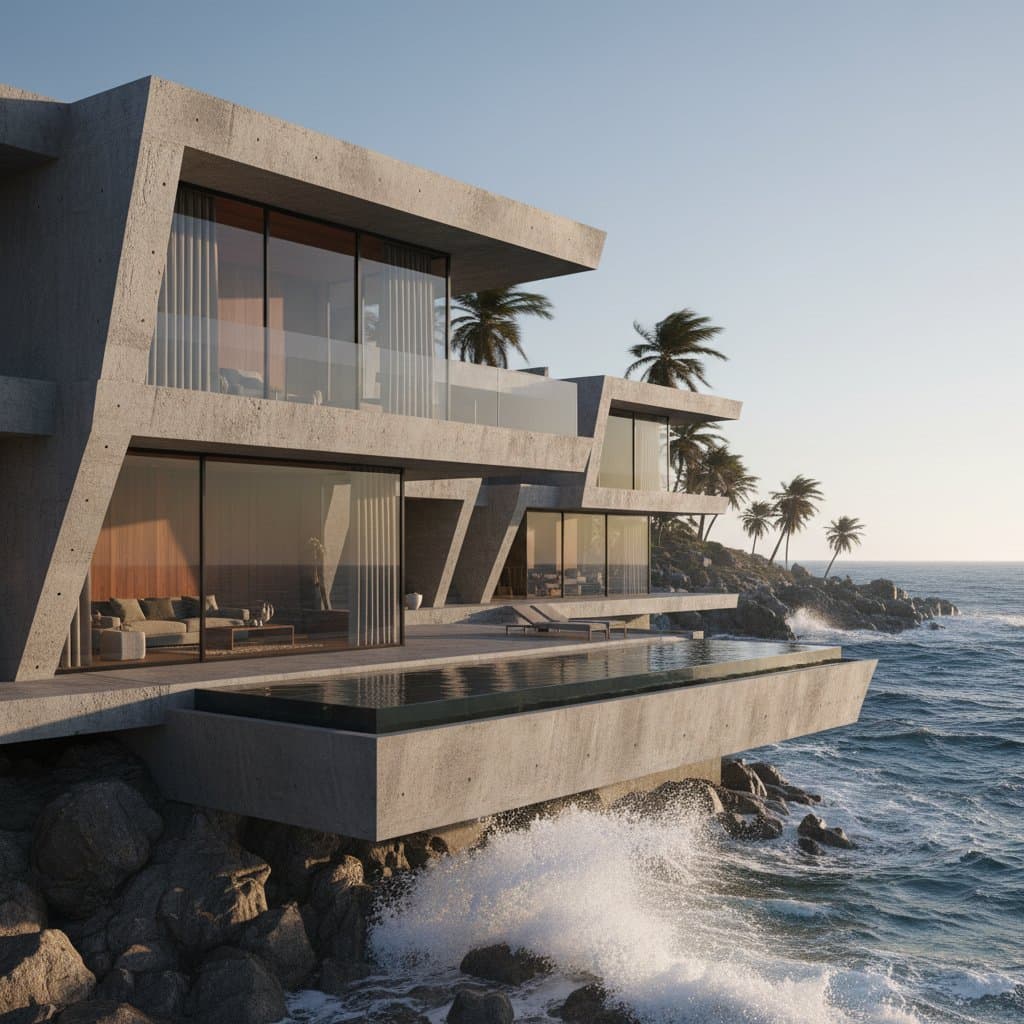
The pared-down essence of brutalism integrates seamlessly with marine surroundings. Geometric configurations and precise boundaries accentuate the terrain without overshadowing it. Consider a singular concrete edifice that extends toward sweeping Pacific panoramas; such restraint permits the environment to command attention.
Image Caption: A streamlined beachfront dwelling featuring bare concrete facades and broad glass apertures facing the ocean.
Concrete as the Coastal Champion
Concrete has long symbolized fortitude, yet in seaside applications, it assumes enhanced significance. Brutalist coastal dwellings leverage this substance for both visual and functional merits.
Key Reasons Concrete Performs Exceptionally at the Seaside
- Durability: Concrete endures saline atmospheres and dampness more effectively than alternative substances.
- Thermal Regulation: Substantial walls stabilize internal climates, maintaining coolness during summer and insulation in milder periods.
- Minimal Upkeep: In contrast to timber cladding needing regular recoating, concrete preserves its condition with little intervention.
- Acoustic Insulation: The material's density inherently dampens marine gusts and ambient sounds, fostering tranquil indoor sanctuaries.
Practical Advice: Apply a permeable sealant to bare concrete to preserve its inherent grain while bolstering resistance to salinity and humidity.
Integrating Brutalism with Warmth and Livability
If brutalism suggests unyielding, monochromatic masses, current practitioners challenge that perception. Coastal brutalism merges unprocessed elements with natural embellishments to yield inviting, habitable environments. Envision honed concrete flooring alongside walnut joinery, textile upholstery, and diffused illumination; the outcome conveys both solidity and opulence.
Harmonizing Unrefined and Polished Elements
- Contrasting Textures: Coarse concrete pairs effectively with sleek glass or organic rock.
- Subdued Hues: Tones drawn from beach sand, weathered timber, and ocean froth infuse coziness.
- Illumination Strategies: Expansive fenestration bathes spaces in daylight, tempering angularity.
- Botanical Accents: Seaside flora or drought-tolerant plants mitigate concrete's uniformity and infuse vitality.
Image Caption: An internal perspective of a brutalist seaside home showcasing concrete partitions, timber vaulting, and wide ocean-facing glazing.
The Sustainability Advantages of Brutalist Construction
Sustainability propels brutalism's resurgence. When combined with advanced methods and regional procurement, concrete fabrication promotes energy conservation and durability. Numerous brutalist seaside projects incorporate recycled fillers or low-energy concrete formulations to lessen ecological footprints.
Core Sustainable Features
| Feature | Benefit |
|---|---|
| Thermal Mass | Diminishes reliance on mechanical climate control |
| Regional Sourcing | Lowers transport-related carbon outputs |
| Passive Strategies | Optimizes airflow and daylight utilization |
| Extended Durability | Reduces long-term material consumption |
These attributes position brutalism as a progressive option for coastal residents prioritizing environmental stewardship alongside architectural endurance. For instance, incorporating fly ash in mixes can cut cement usage by up to 30 percent, further enhancing eco-friendliness without compromising strength.
Why Brutalism Aligns with Contemporary Coastal Lifestyles
Brutalism embodies a subtle assurance. It avoids mimicking quaint seaside bungalows or sleek vitreous estates. Rather, it honors material candor and purposeful design. For those valuing genuineness and structural fidelity, brutalism fulfills these aspirations.
Psychological and Experiential Gains
- Lasting Stability: Concrete forms instill security, shielding against maritime tempests.
- Environmental Integration: The design's restraint allows surroundings to shape the narrative.
- Enduring Allure: It transcends transient trends, ensuring pertinence across generations.
Image Caption: A brutalist seaside abode situated on a craggy promontory, merging fluidly with its locale.
Incorporating Brutalism into Your Coastal Space
For those contemplating renovations or fresh constructions, brutalism may suit your seaside aspirations. Initiate modestly by adopting concrete components such as work surfaces, feature partitions, or exterior vessels.
Essential Guidance for Implementing Coastal Brutalism
- Select regionally produced concrete to minimize ecological burdens.
- Combine concrete shells with timber accents indoors for enhanced livability.
- Employ discreet fixtures to accentuate surface relief and chiaroscuro effects.
- Favor fluid floor plans that amplify circulation and sightlines.
To apply these principles, consult local architects experienced in marine adaptations; they can tailor mixes to specific salinity levels, ensuring longevity.
Experiencing Life in a Coastal Brutalist Home
Brutalism transcends notions of rigidity or intimidation. It represents resilience, transparency, and affinity with locale. In coastal realms, these traits manifest as dwellings that appear hewn from the landscape itself.
Such homes withstand relentless tides, breezes, and temporal shifts. For individuals prepared to reconceptualize seaside allure, brutalism emerges as the quintessential beachfront asset.