
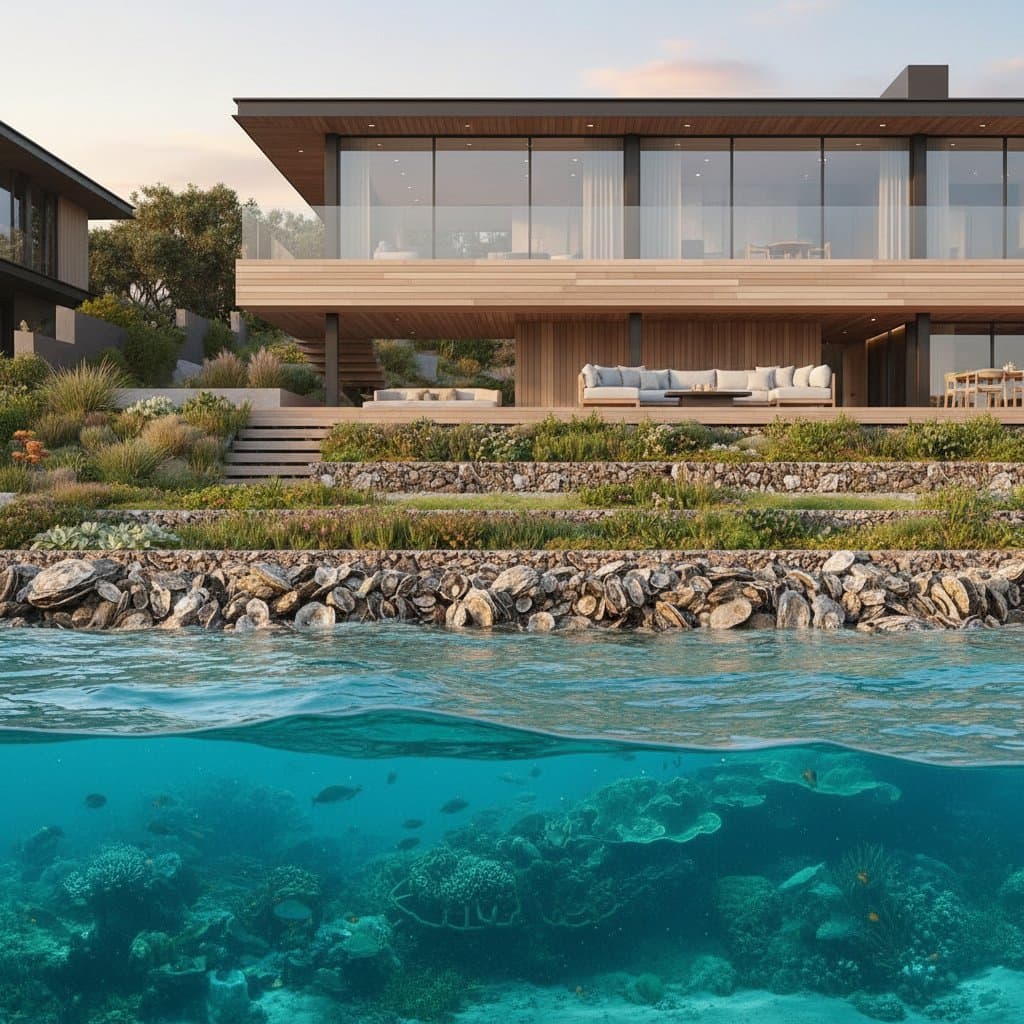
9 Reasons Coastal Homeowners Choose Living Seawalls Over Concrete
Coastal properties face persistent challenges from ocean forces such as saltwater exposure, tidal fluctuations, and wave impacts that degrade traditional concrete seawalls. Homeowners increasingly select living seawalls as a superior, environmentally integrated option that safeguards land while fostering ecological health. These structures gain popularity in coastal landscaping for their ability to harmonize protection with natural enhancement.
Envision a barrier that shields against erosion, invites marine species, purifies water, and integrates with the surrounding landscape. Living seawalls achieve this through engineered designs that merge durability with biological elements. For those seeking resilient and sustainable waterfront solutions, this option merits consideration. The following outlines nine compelling reasons to transition from concrete to living seawalls.
Eco-Friendly Integration with Contemporary Design
1. Living Seawalls Foster Marine Biodiversity
Concrete surfaces present a smooth, barren barrier that repels marine life. In contrast, living seawalls incorporate rough textures, recesses, and modular components resembling natural rock. These elements offer attachment points for oysters, barnacles, and algae, transforming the structure into a vibrant habitat.
Select configurations with diverse surface variations to promote species variety. Such features cultivate a robust local ecosystem along the shoreline.## Practical Steps Toward Eco-Conscious Coastal Management
7. Contribution to Regional Habitat Restoration
Installing a living seawall aids broader coastal recovery initiatives from private land. These barriers serve as breeding grounds for juvenile fish and invertebrates, aiding population recovery. They also encourage adjacent seagrass and kelp development, which anchors sediments and fortifies shoreline stability.
This strategy elevates individual enhancements to community-level ecological benefits.
8. Adaptation to Climate Pressures
Elevated sea levels and intensified storms pose risks to waterfront properties. Living seawalls incorporate adjustable elevations and pliable components that better withstand variable conditions. By leveraging natural mechanisms, they enhance site resilience beyond mechanical defenses alone.
Consult bioengineering specialists to tailor designs to specific wave patterns and soil types.
9. Emerging Standard in Shoreline Enhancement
In coastal regions, living seawalls emerge as a preferred landscape feature. Their fusion of utility and visual appeal attracts residents, while public entities and conservation organizations endorse them within comprehensive restoration plans.
This rising adoption signals a broader commitment to balanced coastal stewardship that prioritizes defense and ecological integrity.
[Image: Aerial view of a coastal neighborhood featuring several living seawall installations]
Essential Guidance for Seawall Projects
To pursue a seawall replacement or upgrade, initiate with a professional site evaluation. Experts in coastal engineering or landscape architecture assess factors like wave intensity, sediment characteristics, and tidal variations to propose optimal configurations.
Core recommendations:
- Secure required regulatory approvals prior to starting work
- Opt for modular assemblies to simplify deployment
- Embed indigenous plants to reinforce stability
- Allocate $400 to $900 per linear foot, varying by material selection and location specifics
Such investments promote enduring property care that supports personal and environmental well-being.
Common Inquiries
What is the expected lifespan of a living seawall?
Properly constructed and biologically matured units endure for decades. The organic reinforcements typically amplify strength progressively.
Do living seawalls cost more than concrete alternatives initially?
Upfront expenses might exceed those of concrete, yet sustained maintenance savings yield overall economic advantages.
Can living seawalls withstand intense wave action?
Affirmative. Their energy-dispersing profiles lessen impact forces and mitigate damage more effectively than planar concrete.
Will living seawalls introduce pests or odors?
Negative. The associated biota forms an equilibrated community without notable scents. Adequate circulation avoids water pooling.
Is retrofitting possible on current concrete seawalls?
Frequently, yes. Attachable modules can overlay existing walls, yielding a combined system with amplified ecological function.
Embracing Resilient Shoreline Solutions
Living seawalls redefine the interface between coastal dwellings and marine environments. They convert protective necessities into avenues for ecological revitalization, aesthetic enhancement, and equilibrium. Selecting this method safeguards assets while honoring the dynamic essence of shorelines.
For waterfront residents, this choice embodies proactive stewardship that shapes enduring coastal harmony.