
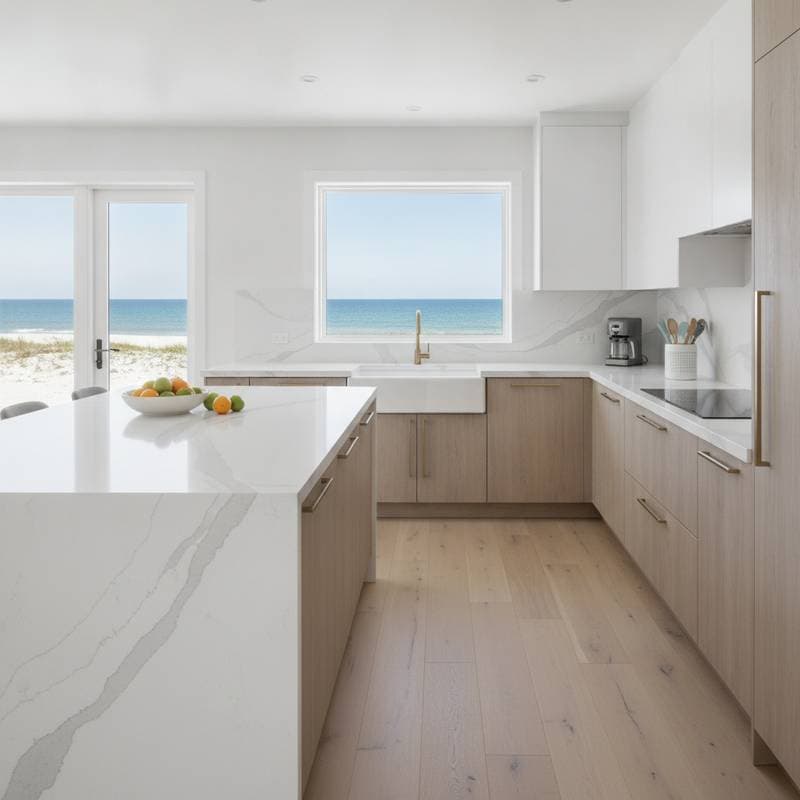
Why Quartz is Replacing Granite in Beach House Kitchens
The modern coastal kitchen is shifting away from traditional natural stone toward a cleaner, more resilient surface. Homeowners who once favored polished granite now select quartz countertops for their beach houses. This change reflects a deeper understanding of maintenance, durability, and long-term value in humid, salt-rich environments.
Quartz offers practical and beautiful solutions for a beach house kitchen remodel. On average, quartz countertops cost between 75 and 150 dollars per square foot installed. Granite typically ranges from 60 to 120 dollars per square foot. Although quartz carries a slightly higher upfront cost, its performance and low maintenance requirements make it a smarter investment for coastal properties.
Why Quartz Performs Better in Coastal Kitchens
Quartz is an engineered stone made from about 90 to 95 percent crushed natural quartz combined with resins and pigments. This manufacturing process creates a dense, nonporous surface that resists stains, moisture, and bacteria. Granite, by contrast, is a natural stone that requires sealing at least once a year to prevent absorption of oils and liquids.
In a beach environment where humidity, salt air, and sand are common, the nonporous quality of quartz provides a major advantage. It eliminates the risk of mold or discoloration that can occur when granite absorbs moisture. Homeowners also appreciate that quartz maintains a consistent pattern and color, which simplifies coordination with cabinetry and flooring.
Comparison Table: Quartz vs. Granite for Beach Houses
| Feature | Quartz | Granite |
|---|---|---|
| Average Installed Cost | 75 - 150 per sq. ft. | 60 - 120 per sq. ft. |
| Maintenance | No sealing required | Annual sealing needed |
| Durability | Highly scratch and stain resistant | Strong but porous |
| Appearance | Uniform patterns and colors | Natural variations |
| Moisture Resistance | Excellent | Moderate |
| UV Resistance | Moderate | Better outdoors |
| Best Use | Indoor kitchens | Indoor and outdoor |
Cost Breakdown for Quartz Countertops
When budgeting for quartz countertops in a beach house, expect the following breakdown per square foot. Material cost ranges from 50 to 100 dollars. Fabrication and edge finishing add 15 to 30 dollars. Installation labor contributes 10 to 20 dollars. Cutouts for sinks or cooktops cost 100 to 250 dollars each.
A typical coastal kitchen with 50 square feet of countertop space totals between 3,750 and 7,500 dollars for complete quartz installation. Premium colors, waterfall edges, or integrated backsplashes can raise the price toward the higher end of that range.
Labor and Installation Considerations
Quartz installation requires experienced fabricators and specialized equipment to cut and polish the material accurately. Labor typically accounts for 15 to 25 percent of the total project cost. Contractors charge an average of 60 to 100 dollars per hour, depending on project complexity and local market rates.
Because quartz slabs are heavy, professional installation remains essential. Attempting a DIY installation can lead to cracking or uneven seams, both of which prove costly to fix. Always verify that the installer uses proper support structures, especially for large islands or overhangs.
Factors That Influence Quartz Countertop Costs
Several variables affect the total cost of a quartz countertop project. Slab thickness comes in standard options of 2 centimeters or 3 centimeters. Thicker slabs cost more but provide a more substantial appearance. Edge style options include eased, beveled, or bullnose profiles as standard choices. Decorative edges such as ogee or mitered designs increase cost.
Color and pattern also matter. Solid light shades remain common and affordable. Veined or custom-colored slabs cost more. Backsplash integration with full-height quartz adds both visual impact and additional expense. Coastal areas often carry slightly higher labor costs due to transportation and availability.
How to Save Money on Quartz Countertops
- Choose standard colors. Manufacturers offer bulk pricing on popular shades such as white, gray, or beige.
- Use remnants. Smaller sections or islands can often be made from leftover pieces at a discount.
- Simplify edges. Stick to basic profiles rather than intricate custom cuts.
- Limit seams. Fewer seams reduce fabrication time and waste.
- Compare installers. Request at least three quotes to ensure competitive pricing.
DIY vs. Hiring a Professional
While some homeowners may handle minor remodeling tasks themselves, quartz countertops are not well suited for DIY installation. The slabs are extremely heavy, and precision cutting requires industrial saws and polishing tools.
DIY Pros
- Savings on labor costs
- Flexibility with timing
DIY Cons
- Risk of damage to the slab
- No warranty on installation errors
- Limited access to professional-grade tools
Hiring a Professional Pros
- Precise measurements and seamless joints
- Warranty coverage on workmanship
- Efficient, safe installation
Hiring a professional may cost more initially, yet it ensures that the investment looks and performs properly for years.
Common Mistakes to Avoid
- Skipping professional measurement. Even a small miscalculation can lead to costly gaps or uneven surfaces.
- Ignoring cabinet support. Quartz is dense and requires strong base cabinets to prevent cracking.
- Using harsh cleaners. Avoid abrasive pads or bleach-based products that can dull the finish.
- Choosing dark colors in sunny spaces. Prolonged exposure to sunlight may cause slight fading in darker quartz tones.
Frequently Asked Questions About Quartz Countertops in Beach Houses
Do quartz countertops fade in coastal sunlight?
Quartz offers moderate resistance to UV rays, yet excessive direct sunlight can cause minor fading over time. For kitchens with large windows or skylights, choose lighter colors to minimize visible changes.
Are quartz countertops completely waterproof?
Yes. Because quartz is nonporous, it does not absorb water or harbor mold. This quality makes it one of the best materials for humid coastal environments.
How long do quartz countertops last?
With proper care, quartz countertops can last as long as the home itself. The surface resists scratches, stains, and cracks while maintaining its shine for decades without needing resealing.
Can I use quartz outdoors?
Quartz works best for indoor spaces. Prolonged exposure to direct sunlight and weather can degrade the resin binders. For outdoor kitchens or bars, granite or porcelain slabs are more suitable.
What cleaning routine works best for quartz?
Use a soft cloth with mild soap and warm water for daily cleaning. For tougher spots, a nonabrasive glass cleaner works well. Avoid acidic or high-pH products that might dull the surface.
Does quartz add resale value to a beach house?
Quartz countertops enhance resale appeal in coastal markets because buyers recognize the low-maintenance benefits and consistent appearance in humid conditions.
Selecting Quartz for Long-Term Coastal Performance
Choosing quartz countertops for a beach house blends practicality with beauty. The surface stands up to sea air, humidity, and everyday use while delivering reliable performance over time. Visit local showrooms to examine quartz samples in person and compare textures, colors, and finishes under natural light.