
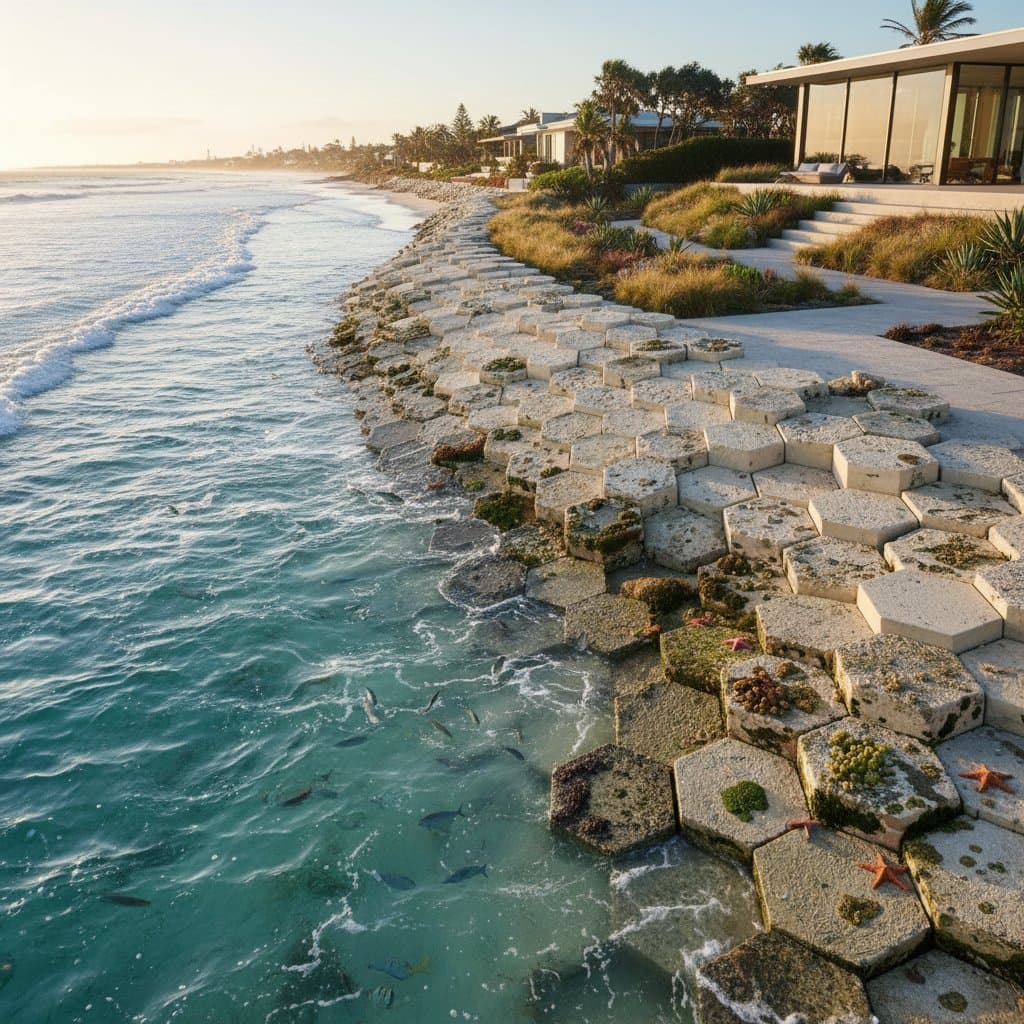
Reef Tiles: A Cost-Effective Alternative to Traditional Seawalls
Coastal property owners face persistent challenges from erosion, where waves and tides gradually erode shorelines and threaten structures. Traditional seawalls provide protection but often involve substantial expenses and environmental drawbacks. Reef tiles emerge as a practical solution, delivering shoreline defense at an average cost of $8,000 while fostering marine ecosystems.
Key Advantages
- Reef tiles provide an economical method for controlling coastal erosion.
- They establish habitats that enhance marine biodiversity along shorelines.
- Installation requires less disruption than conventional seawalls.
- These structures integrate seamlessly with natural landscapes, minimizing aesthetic impact.
- Maintenance demands remain minimal in contrast to concrete or steel barriers.
- Homeowners benefit from an environmentally responsible approach to erosion management.
Understanding Reef Tiles
Reef tiles consist of modular, interlocking units crafted from sustainable concrete composites. These materials replicate the contours and textures of natural reefs. The design enables tiles to absorb wave energy, mitigate shoreline erosion, and promote the growth of coral and other marine species.
Each tile features cavities and ridges that offer refuge for organisms such as seaweed, oysters, and juvenile fish. Placement occurs along beaches, in coastal yards, or near docks to create a barrier that harmonizes with the environment. In contrast to seawalls, which redirect wave energy and exacerbate erosion elsewhere, reef tiles dissipate forces gradually, preserving the shore more effectively.
[Photo: A coastal section reinforced with reef tiles, displaying emerging marine plants and coral.]
Economic Benefits
Conventional seawalls typically range from $20,000 to $100,000, influenced by project scale, materials, and engineering needs. Reef tile installations average $8,000, encompassing materials and standard setup. This affordability suits modest properties and budget-conscious owners prioritizing sustainability.
Consider this comparison:
| Project Type | Estimated Cost | Maintenance Needs | Environmental Benefit |
|---|---|---|---|
| Traditional Concrete Seawall | $30,000 - $100,000 | High | Low |
| Riprap (Rock Barrier) | $15,000 - $40,000 | Moderate | Moderate |
| Reef Tile System | $8,000 - $15,000 | Low | High |
Budget an additional 20 percent for site preparation and potential modifications to account for variables like soil conditions or access challenges.
Superior Performance Over Seawalls
Seawalls, as rigid barriers, often lead to scour, where intensified water flow undermines the foundation and harms adjacent habitats. Reef tiles prove more adaptable due to their porous construction, which permits water circulation and reduces stress on the shoreline.
Primary Advantages
- Habitat Creation: Textured profiles draw in marine species, aiding biodiversity recovery.
- Energy Absorption: Contoured forms diffuse wave impacts, safeguarding the coast.
- Visual Integration: Mimicking natural rocks, tiles enhance rather than dominate the scenery.
- Durability: Reinforced components withstand marine exposure without rapid degradation.
- Permitting Simplicity: Regulatory approvals frequently proceed more swiftly for these nature-based solutions.
[Photo: Detailed view of reef tile units, illustrating coral and algae attachment.]
Process for Installation and Upkeep
Reef tile deployment involves minimal disturbance, achievable by a compact team in a matter of days with equipment like a portable crane or marine vessel.
Essential Steps
- Assess the Site: Analyze erosion trends, wave patterns, and tidal influences to inform decisions.
- Plan the Configuration: Specify tile arrangement, submersion depth, and intervals based on local conditions.
- Position the Tiles: Secure and connect units along the water's edge or submerged foundation.
- Conduct Ongoing Checks: Inspect for movement following significant weather events.
- Facilitate Colonization: Permit natural attachment of marine life, which reinforces stability over time.
Upkeep focuses on routine evaluations and clearing accumulated debris. As organisms adhere, the system evolves into a self-sustaining, biological shield.
Advantages and Limitations
| Advantages | Limitations |
|---|---|
| Cost savings relative to seawalls | Not ideal for densely developed coasts |
| Promotes ecological diversity | Demands tailored site evaluation |
| Requires little ongoing care | Initial biological establishment delays |
| Complements coastal aesthetics | Availability varies by location |
Engage a specialist in living shoreline technologies to verify compatibility with your property's unique features.
Practical Implementations
Homeowners along coastlines and operators of boutique resorts increasingly adopt reef tiles for beach preservation. In various communities, installations yield evident erosion stabilization within the first few months. Moreover, these projects revive ecosystems, with observations of increased populations of fish, crustaceans, and seagrasses in formerly depleted zones.
[Photo: A residence on the waterfront secured by reef tiles, featuring transparent waters and observable aquatic activity.]
Steps to Implement Reef Tiles
For those considering shoreline protection that avoids extensive concrete infrastructure, reef tiles deliver equilibrium among expense, appearance, and ecological stewardship. Start by reaching out to a certified marine contractor or shoreline expert versed in bio-engineered defenses. Inquire about assessments for your location, necessary approvals, and possibilities for personalization to match specific needs.
Stable shores teeming with life enhance the essence of coastal residency. Reef tiles realize this outcome through innovative, harmonious design.