
9 Proven Living Shoreline Strategies to Reduce Seawall Costs by 50 Percent
Coastal property owners confront significant erosion risks that threaten waterfront land. Traditional seawalls demand substantial initial investments and ongoing repairs. Living shorelines provide a superior alternative, leveraging natural elements to deliver protection at half the expense while fostering healthier coastal environments.
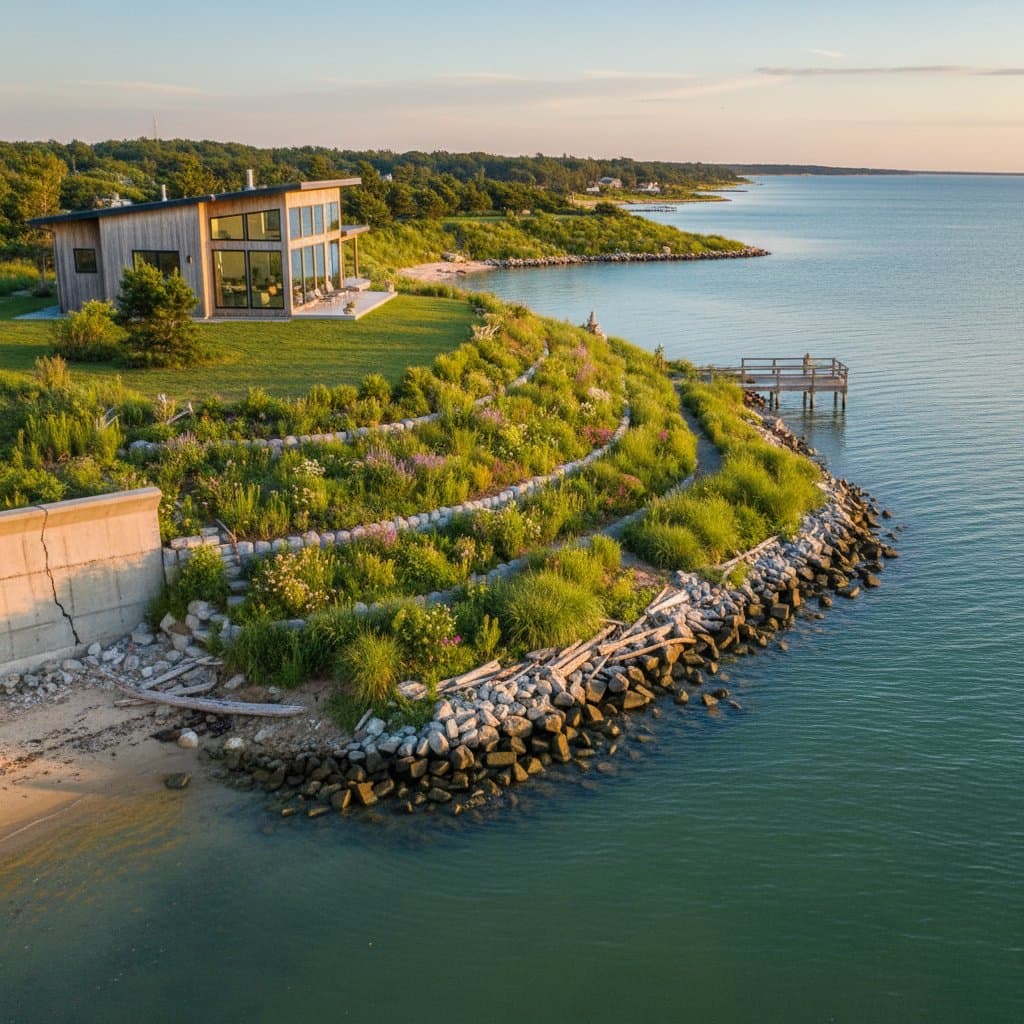
Witnessing waves erode shoreline evokes a sense of vulnerability. Living shorelines counter this by integrating native vegetation, barriers, and strategic layouts to form a resilient buffer. These systems stabilize soil, mitigate erosion, and support diverse marine species.
This guide details the mechanics of living shorelines, their economic advantages over seawalls, and specific implementation steps to secure your property effectively.
[Image: Peaceful coastal property with a vegetated living shoreline protecting against waves]
Natural Design Strategies
1. Plant Native Marsh Grasses for Erosion Control
Marsh grasses such as cordgrass and saltgrass secure soil through extensive root networks. These plants dissipate wave energy, moderate water velocity, and capture sediments that prevent further land loss.
Pro Tip: Arrange grasses in staggered rows oriented perpendicular to the shoreline to optimize wave dissipation. Installation costs range from $3 to $5 per square foot, significantly below those of concrete structures.
2. Establish a Gentle Slope Rather Than a Steep Drop-Off
A gradual slope dissipates wave momentum progressively before it impacts the property line. This configuration minimizes the requirement for tall, costly barriers. Reinforce the slope using layers of sand, gravel, or biodegradable fiber mats.
Property owners typically observe diminished erosion rates within one season following slope installation.
3. Incorporate Oyster Reefs or Mussel Beds
Shellfish structures function as dynamic breakwaters, attenuating waves and accumulating sediments that bolster shoreline integrity over time. Community restoration initiatives frequently supply materials and labor support for such installations.
Pro Tip: Contact regional environmental agencies for oyster bag or reef ball programs, which often include grant funding or cost subsidies.
[Image: Oyster reef structure protecting a coastal shoreline]
Eco-Friendly Barriers and Buffers
4. Deploy Coir Logs for Instant Stabilization
Coir logs consist of cylindrical, biodegradable forms crafted from coconut fibers. They retain soil integrity during the establishment phase of vegetation. As the logs decompose, they contribute to a fortified, plant-covered embankment.
These logs cost between $6 and $10 per linear foot, positioning them as an economical and sustainable substitute for rigid concrete elements.
5. Construct a Living Breakwater
Living breakwaters involve submerged arrangements of rocks or shells positioned offshore. They temper incoming waves and cultivate habitats for aquatic species including fish, crabs, and shellfish.
This method lowers maintenance expenses by up to 50 percent in the long term, as biological processes enhance structural durability rather than erode it.
6. Integrate Native Shrubs and Trees for Enhanced Stability
Species such as mangroves, willows, or beach plum shrubs defend against wind and wave forces while adding aesthetic and shading benefits. Their interlocking roots fortify soil against slumping and structural failure.
Pro Tip: Select varieties resilient to saline exposure and tidal fluctuations to promote high survival rates and vigorous development.
[Image: Native shrubs and grasses forming a stable coastal edge]
Maintenance and Long-Term Management
7. Conduct Annual Monitoring and Replanting
Living shorelines require consistent oversight to maintain efficacy. Evaluate conditions post-storm events, replace compromised vegetation, and replenish sediments as necessary. Such proactive measures preserve system robustness at minimal expense.
Annual maintenance for modest residential sites remains below $500, in stark contrast to the thousands spent on seawall upkeep.
8. Promote Habitat Diversity
Incorporating multiple plant varieties builds system resilience. Should one type underperform, alternatives compensate effectively. Diverse plantings also draw beneficial wildlife like birds, fish, and pollinators that sustain ecological balance.
Incorporate a minimum of three native grass or shrub species to achieve optimal outcomes.
9. Collaborate with Local Coastal Specialists
Engaging environmental engineers or marine biologists customizes designs to site-specific conditions. Numerous coastal initiatives provide complimentary or subsidized evaluations. Expert input guarantees compliance with regulations and optimizes protective performance.
Pro Tip: Develop an integrated plan that merges natural elements with selective structural supports to balance affordability and endurance.
[Image: Coastal consultant assessing a living shoreline project]
Practical Implementation Tips
- Begin modestly. Test a single shoreline segment prior to full-scale rollout.
- Source materials locally. Utilize nearby sand, rocks, and plants for superior adaptation to regional conditions.
- Layer protective elements. Combine vegetation with oyster reefs or rock sills to create multifaceted defenses.
- Pursue financial support. State agencies and conservation groups offer grants and incentives for living shoreline initiatives.
Frequently Asked Questions
What defines a living shoreline?
A living shoreline represents a nature-based coastal defense method that employs vegetation, sand, and organic components in place of concrete or metal seawalls. It curbs erosion and elevates habitat integrity.
How much less expensive are living shorelines compared to traditional seawalls?
Based on project specifications and materials, living shorelines incur up to 50 percent lower construction and maintenance costs. Seawalls necessitate extensive machinery and frequent interventions, whereas living systems gain strength progressively.
Do living shorelines withstand severe storms?
Yes, appropriately engineered designs absorb and redirect wave forces to limit impacts. Post-storm repairs prove feasible, with recovery occurring more swiftly than for inflexible barriers.
Are permits required for installation?
Permitting applies in most jurisdictions, though procedures simplify relative to seawall approvals. Environmental authorities generally endorse these projects for their positive ecological contributions.
How long until vegetation establishes fully?
Most species develop robust root systems within one to two growing seasons. Accelerate progress with erosion-control mats or coir logs.
Securing Your Shoreline Investment
Living shorelines unite aesthetic appeal, durability, and fiscal efficiency. They safeguard properties, nurture biodiversity, and deepen connections between communities and natural coastal dynamics. Through native resources and professional collaboration, property owners achieve enduring preservation at reduced costs.