
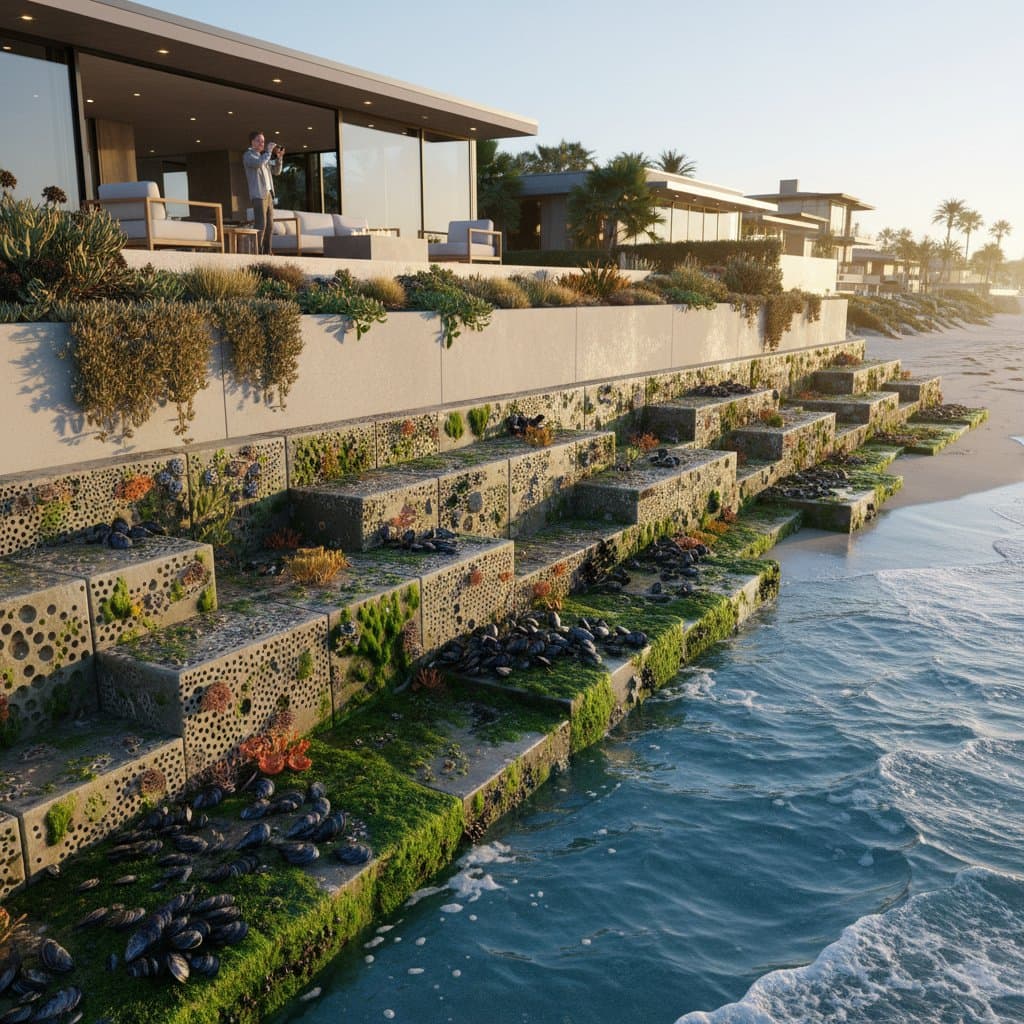
Living Seawalls: Eco-Friendly Erosion Fix for 2026
Coastal homeowners face the challenge of gradual shoreline erosion that threatens property and landscapes. Traditional seawalls provide protection but frequently exacerbate issues like scouring nearby beaches. Living seawalls represent an advanced approach that integrates engineering with ecological restoration, safeguarding coastlines while fostering marine habitats. These structures transform defensive barriers into vibrant ecosystems that benefit both property owners and the environment.
Highlights
- Living seawalls integrate rigid infrastructure with living elements to enhance coastal resilience
- They mitigate erosion and promote diverse marine species
- Expenses fluctuate according to materials, project scale, and environmental factors
- These solutions suit high-risk areas such as San Diego's vulnerable shores
- Long-term upkeep proves more economical compared to conventional concrete installations
What Is a Living Seawall?
A living seawall functions as a coastal defense mechanism designed to replicate natural shoreline features. Engineers construct it using modular panels with textured surfaces that encourage attachment of marine organisms like oysters, barnacles, and algae. These biological elements reinforce the wall's integrity and enhance surrounding water quality. This design blends the durability of a standard seawall with the vitality of an artificial reef.
Photo: A curved living seawall with panels textured for marine growth, now supporting seaweed and mussels.
Conventional seawalls redirect wave energy, often accelerating erosion in adjacent areas. In contrast, living seawalls dissipate waves through their irregular surfaces and biological layers. The resulting nooks and ledges draw in fish, crustaceans, and other species, evolving barren concrete into productive underwater habitats over time.
Why Living Seawalls Are Gaining Popularity
Rising sea levels and intensified storms drive the demand for sustainable coastal defenses. Property owners and municipalities now prioritize solutions that preserve assets without degrading ecosystems. Living seawalls align with this trend by delivering robust protection alongside environmental gains.
Benefits at a Glance
| Feature | Living Seawall | Traditional Seawall |
|---|---|---|
| Erosion Control | Excellent | Good |
| Marine Habitat | Supports biodiversity | Limited or none |
| Aesthetic Appeal | Natural and textured | Plain concrete |
| Maintenance | Low after establishment | Moderate to high |
| Longevity | High with proper care | Moderate |
Tip: Select designs that incorporate native species and adapt to regional tide cycles for optimal habitat development.
How Much Does a Living Seawall Cost?
The expense of installing a living seawall varies by site specifics, material selections, and project scope. Homeowners typically budget between $300 and $800 per linear foot. Although initial costs exceed those of basic concrete options, savings from minimal ongoing maintenance and prolonged service life justify the investment.
Factors That Influence Price
- Site conditions: Foundations differ for rocky versus sandy substrates, impacting preparation needs.
- Material choice: Options like permeable eco-concrete or prefabricated habitat modules affect pricing.
- Design complexity: Features such as varied textures for species diversity raise fabrication costs.
- Permitting and installation: Compliance with regional regulations influences labor and approval timelines.
Photo: Workers anchoring sustainable panels to a San Diego coastal site during installation.
The Science Behind Living Seawalls
Engineers base living seawall designs on analyses of local hydrology, including tide fluctuations and sediment dynamics. Textured panels and integrated crevices facilitate rapid colonization by algae and invertebrates, which bind to the surface and add structural support. Advanced versions incorporate sustainable materials, such as recycled aggregates or 3D-printed forms optimized for water flow.
As the biological community develops, it filters nutrients, stabilizes sediments, and softens wave impacts. This synergy yields a self-reinforcing system that elevates water clarity and reduces downstream erosion. Researchers observe that mature installations can increase local fish populations by up to 50 percent within the first year.
Installation Process: What to Expect
Property owners pursuing a living seawall encounter a structured implementation sequence tailored to site demands. Begin with a professional assessment to map erosion risks and ecological baselines. This informs a bespoke design that aligns with environmental objectives.
Subsequent steps include securing permits from relevant agencies, which verify the project's alignment with conservation standards. Construction involves positioning and securing modular units, often completed in phases to minimize disruption. Post-installation monitoring ensures habitat establishment and structural stability, with adjustments as needed.
- Assessment: Experts survey the site for erosion patterns and marine conditions.
- Design phase: Modules are engineered to support target species and withstand local forces.
- Permitting: Plans undergo review for regulatory compliance.
- Construction: Panels are deployed and fixed in place.
- Monitoring: Growth and performance are evaluated over months.
Tip: Engage contractors certified in ecological engineering to navigate complexities and achieve superior outcomes.
Photo: Detailed image of a seawall panel displaying established coral fragments and mussel clusters after months of exposure.
Long-Term Benefits for Coastal Communities
Beyond immediate protection, living seawalls enrich marine environments by providing refuge for juvenile fish and filtering urban runoff. In areas like San Diego, they enhance biodiversity hotspots that support fisheries and tourism. Enhanced shorelines also invite activities such as eco-tours and wildlife observation, boosting community engagement.
These installations fortify regional adaptation strategies against climate pressures. By diminishing repair frequencies associated with rigid barriers, they lower public expenditures and promote integrated land-sea management. Over decades, the cumulative ecological uplift contributes to healthier bays and resilient infrastructure.
Advancing Coastal Resilience Through Living Seawalls
For waterfront residents, adopting a living seawall offers a strategic path to secure properties amid evolving environmental challenges. Consult specialists in bioengineered defenses to explore viable configurations. Obtain multiple estimates, evaluate habitat integration potential, and align the project with broader sustainability aims. This investment not only preserves shorelines but also cultivates enduring ecological harmony.