
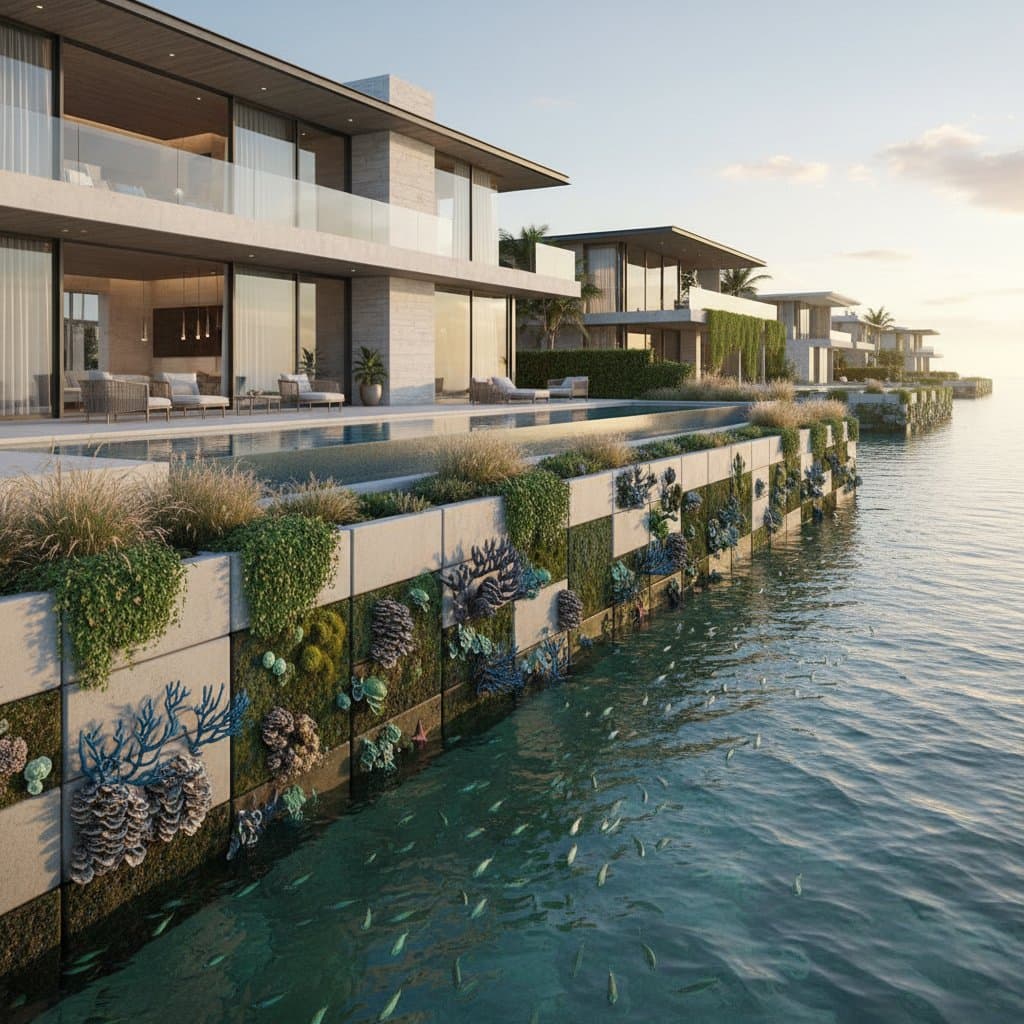
Nine Strategies for Living Seawalls: Effective Erosion Control for Waterfront Properties
Waterfront properties offer serene views and recreational opportunities, yet they face persistent erosion from waves and tides that undermine shorelines and jeopardize structural integrity. Conventional concrete seawalls have long served as barriers, but they frequently harm aquatic environments by reflecting wave forces and limiting habitat formation. Property owners seek alternatives that provide robust defense without ecological compromise.
Living seawalls address this need by merging bioengineered components with natural features. These systems stabilize shores, cultivate diverse marine life, and filter pollutants from water. They transform defensive structures into thriving ecosystems, populated by algae, shellfish, and fish that reinforce the barrier naturally. For waterfront residents, adopting living seawalls represents a forward-thinking investment in both property security and environmental health.
The following outlines nine targeted strategies for implementing living seawalls. Each approach emphasizes design, installation, and upkeep to achieve optimal performance tailored to specific coastal conditions.
Core Structural Enhancements for Durability
1. Modular Habitat Panels
Modular panels form the foundation of many living seawalls, securing to new or existing structures with textured surfaces that promote organism attachment. Select panels crafted from marine-grade concrete infused with recycled plastics or sustainable aggregates to minimize environmental impact.
Installation involves affixing panels in targeted zones, such as high-erosion areas, using corrosion-resistant anchors. Over months, surfaces develop biofilms that attract sessile species, enhancing structural adhesion.
Implementation Advice: Assess site-specific wave patterns to determine panel density; denser configurations suit high-energy coasts, while sparser ones fit calmer inlets.
[Image: Textured modular panels exhibiting early marine colonization]
2. Bio-Engineered Concrete Formulations
Standard concrete releases alkaline substances that deter marine settlement, but bio-concrete incorporates additives like crushed oyster shells, alginate, or microbial agents to foster growth. These mixtures achieve a neutral pH akin to ocean water, inviting barnacles, algae, and corals to colonize.
Prepare bio-concrete by blending aggregates with binding agents during pouring or casting. The resulting surface evolves into a self-reinforcing layer as organisms secrete binding materials.
This method not only bolsters wall integrity but also mitigates chemical runoff, benefiting adjacent waters.
3. Wave-Attenuating Profiles
Vertical seawalls intensify erosion by rebounding waves, whereas curved or terraced profiles dissipate energy effectively. Curved designs channel forces skyward, reducing undercutting, while terraced steps create cascading buffers that fragment incoming surges.
Construct these profiles using precast segments or molded forms, ensuring seamless integration with foundational footings. The resulting ledges and pools serve as nurseries for intertidal species like anemones and periwinkles.
[Image: Terraced seawall profile forming natural tide pools]
Habitat-Focused Integrations
4. Shellfish Reef Attachments
Oysters and mussels excel at water filtration and sediment binding, making them ideal for seawall enhancement. Establish shellfish zones by embedding mesh bags of cultured spat or recycled shells into wall faces at mid-tide levels.
As colonies mature, they form interlocking mats that absorb impacts and clarify water by processing nutrients. Monitor recruitment rates to ensure even distribution and supplement with additional seeding if growth lags.
This strategy yields measurable improvements in local water quality within the first year.
5. Emergent Vegetation Zones
Above-water portions of seawalls benefit from salt-tolerant natives such as Spartina alterniflora or Distichlis spicata, which stabilize upper soils and intercept stormwater pollutants. Plant these species along the crest using rhizome divisions or plugs inserted into pre-drilled pockets.
Secure plantings with jute netting or coconut fiber rolls until roots penetrate deeply. The vegetation supports pollinators and shorebirds, extending habitat benefits landward.
Implementation Advice: Select varieties adapted to local salinity and select test plots to evaluate establishment success before full-scale planting.
[Image: Seawall crest lined with established native cordgrass]
6. Submerged Rock Armors
At the seawall base, strategic rock placements create breakwaters that fragment waves and offer refuge for mobile species. Source angular stones from nearby quarries to align with regional geology, stacking them in interlocking layers to a height of one to two meters.
This configuration reduces direct wave assault on the wall while fostering crevices for lobsters and juvenile fish. Periodic repositioning maintains alignment after sediment shifts.
Sustained Management Practices
7. Biannual Ecological Assessments
Marine accretion strengthens living seawalls, yet unchecked overgrowth risks obstruction or instability. Conduct inspections in spring and fall, diving or using underwater cameras to evaluate coverage and identify stressors.
Trim excessive macroalgae and excise invasives like Caulerpa taxifolia promptly. Record observations in a log to inform future adjustments.
Implementation Advice: Engage certified divers for thorough surveys, capturing metrics on species richness to gauge ecosystem health.
8. Gentle Surface Maintenance
Preserve beneficial biofilms through non-abrasive methods, employing seawater rinses at low pressure and nylon brushes for debris removal. Schedule cleanings post-storm events to address sediment buildup without disrupting settlements.
Examine seams and fasteners for wear, tightening or replacing as necessary to uphold structural soundness. These routines extend service life while preserving ecological functions.
9. Progressive System Expansions
Living seawalls adapt to changing conditions, allowing incremental enhancements like adding photovoltaic-integrated panels for monitoring or expanding reef sections. Begin with pilot installations to test efficacy, then scale based on performance data.
This modular evolution accommodates budget constraints and evolving environmental needs, ensuring long-term viability.
Essential Implementation Guidance
Engage coastal engineers and ecologists early to model wave dynamics and habitat potential. Review municipal codes governing shoreline alterations to secure permits. Blend hard and soft engineering for comprehensive protection, factoring in tidal ranges, solar exposure, and prevailing currents.
Common Inquiries
What defines a living seawall?
It integrates structural barriers with biotic elements to curb erosion and nurture aquatic communities, emulating natural coastal processes.
What are the installation costs?
Expenses depend on scale and complexity, typically exceeding basic seawalls initially but offsetting through lower upkeep and enhanced durability.
Is retrofitting feasible for legacy structures?
Affirmative; attach habitat modules or coatings to convert conventional walls into bioactive ones with minimal disruption.
Do they invite problematic invasives?
Proper oversight fosters equilibrium; vigilant monitoring curbs undesirable introductions.
What is their expected lifespan?
Decades of service are common with diligent care, surpassing rigid alternatives via organic fortification.
Realizing Resilient Coastal Harmony
Implementing living seawalls fuses engineering precision with ecological stewardship, yielding shorelines that defend assets and invigorate habitats. This approach empowers waterfront owners to cultivate enduring, vibrant environments that withstand coastal pressures.