
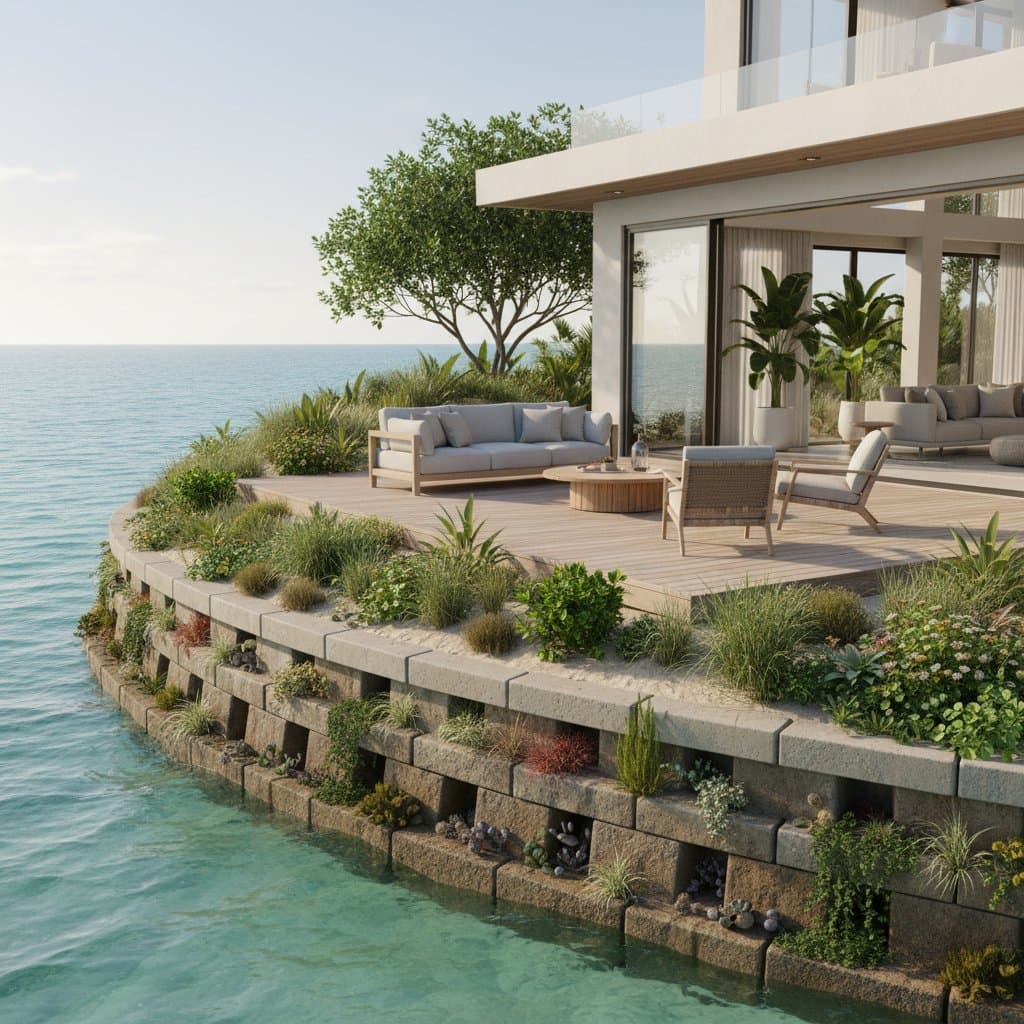
How Living Seawalls Reduce Coastal Erosion by 60 Percent Compared to Bulkheads
Coastal homeowners and communities confront ongoing challenges in safeguarding shorelines from erosion while maintaining the aesthetic and ecological integrity of coastal areas. Traditional bulkheads serve as straightforward barriers between land and water. However, these rigid structures frequently exacerbate erosion and eliminate essential habitats for marine species.
Living seawalls alter this approach. These contemporary, environmentally conscious defense systems merge structural integrity with biological elements. They incorporate textured panels, indigenous plants, and embedded habitats to dissipate wave energy and reconstruct marine ecosystems. Studies indicate that living seawalls diminish coastal erosion by up to 60 percent relative to bulkheads. The outcome yields a durable, evolving shoreline that gains strength progressively.
For individuals residing near waterways or interested in coastal conservation, grasping the superior performance of living seawalls over conventional barriers aids in selecting informed, enduring options for properties and environmental health. The following outlines nine primary advantages of living seawalls in managing coastal erosion.## Performance Benefits Relative to Bulkheads
4. Minimized Wave Reflection and Base Scouring
Bulkheads reflect wave energy seaward, intensifying erosion at their foundations. Living seawalls feature uneven surfaces that disperse and absorb incoming waves. Consequently, they experience reduced undermining and maintain a steadier shoreline contour.
This configuration also averts the scouring that leads to bulkhead failures within a few years. With routine upkeep, living seawalls endure longer and demand fewer costly interventions.
5. Responsiveness to Shifting Environmental Conditions
Living seawalls function as adaptive mechanisms that evolve with alterations in marine environments. As flora expands and biota establishes, the assembly fortifies itself, forming a self-reinforcing shield. Bulkheads, conversely, deteriorate steadily and necessitate periodic substitution.
The evolutionary capacity of living seawalls suits areas prone to sea level rise or fluctuating tides. The synergy of rigid engineering and organic elements delivers both adaptability and security.
6. Decreased Costs for Ongoing Upkeep
Initial outlays for living seawalls may exceed those of bulkheads marginally, yet they yield savings over extended periods. Bulkheads commonly require repairs, bolstering, or complete renewal following storms. Biological processes in living seawalls facilitate inherent restoration.
Practical Recommendation: Conduct yearly evaluations to assess vegetation vitality and sediment accumulation. Minimal efforts sustain the system's efficacy for decades.
[Image: Illustrative diagram contrasting wave energy reflection on a bulkhead versus a living seawall]
Broader Environmental and Societal Gains
7. Elevation of Water Quality and Carbon Absorption
Organisms colonizing seawall exteriors filter pollutants and particulates, resulting in purer coastal waters. Aquatic vegetation and algae sequester carbon dioxide, aiding in atmospheric carbon reduction and elevating local air standards.
These inherent mechanisms position living seawalls as vital ecological partners. By reinstating natural processes, they cultivate resilient coastal settings advantageous to both fauna and human populations.
8. Augmented Visual Appeal and Property Appreciation
Conventional bulkheads appear harsh and utilitarian, whereas living seawalls harmonize with surrounding landscapes. Property owners frequently observe that the verdant, textured facades elevate aesthetic value and integrate with coastal gardens.
Eco-oriented shoreline defenses can elevate property worth, particularly in markets valuing sustainability. A thoughtfully constructed living seawall serves as a practical and ornamental highlight.
Complexity Assessment: Intermediate level, with professional consultation advised for optimal outcomes.
9. Fostering Community Involvement and Learning
Living seawalls draw engagement from educational institutions, researchers, and community members. They function as living laboratories for marine studies and exemplify sustainable practices. Such involvement heightens awareness of coastal care and promotes wider implementation.
- Advances ecological education
- Cultivates communal investment
- Spurs subsequent preservation initiatives
[Image: Group of students examining marine colonization on a living seawall in a seaside community]
Guidance for Coastal Property Owners
Prior to pursuing a living seawall, heed these actionable steps for optimal results:
- Evaluate Regional Regulations. Permitting standards differ by location; consult coastal authorities early.
- Collaborate with Specialized Contractors. Expert engineering ensures sustained effectiveness.
- Prioritize Local Flora and Fauna. Indigenous selections adapt readily and demand little intervention.
- Establish Monitoring Protocols. Consistent checks detect concerns promptly and preserve functionality.
Practical Recommendation: Pair living seawalls with complementary measures like dune stabilization or oyster bed creation for enhanced defense.
Frequently Addressed Queries
What is the cost differential between living seawalls and bulkheads?
Living seawalls generally incur 10 to 25 percent higher installation expenses than bulkheads, though reduced maintenance and extended service life offset these through long-term economies.
Do living seawalls perform in areas with intense wave activity?
Yes, appropriately designed versions withstand vigorous waves. Durable components and energy-dissipating features prove essential.
Is retrofitting an existing bulkhead to a living seawall feasible?
Often, yes. Modular additions or biological enhancements convert standard structures into supportive hybrids.
Which plants and creatures colonize living seawalls?
Typical inhabitants encompass oysters, barnacles, mussels, algae, and halophytic grasses. Assemblages vary by salinity, depth, and climate.
Are living seawalls appropriate for private residences?
Certainly. Scalable designs accommodate modest home fronts or expansive sites, delivering protection and elegance.
Advancing Sustainable Coastal Protection
Living seawalls embody an intelligent, enduring strategy for erosion mitigation. They unite engineered robustness with natural vitality, yielding barriers that mature and fortify progressively.
Opting for living seawalls instead of bulkheads secures shorelines while nurturing vibrant ecosystems poised to persist across generations.