
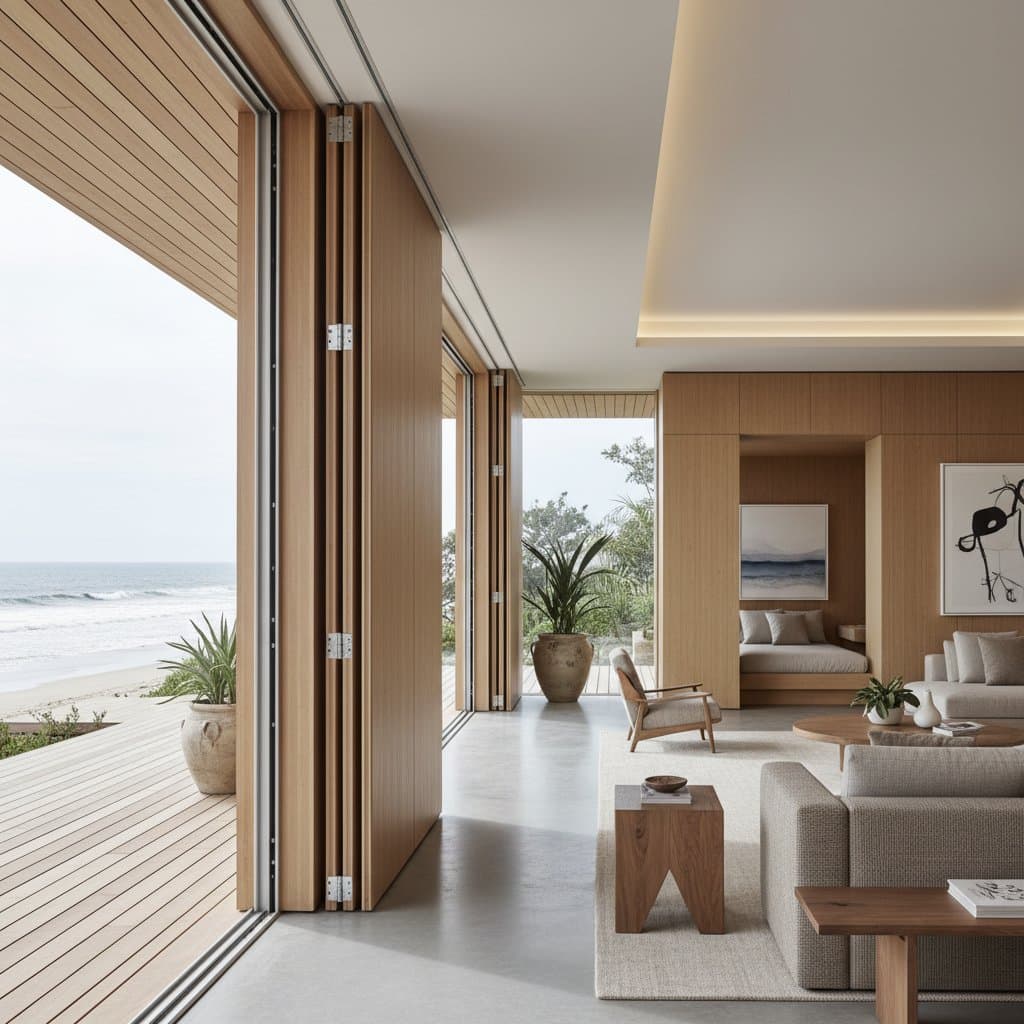
9 Living Hinge Ideas for Flexible Walls in Coastal Homes
Coastal homes traditionally balance the dynamic relationship between natural surroundings and built environments. Homeowners seek spaces that remain open, airy, and linked to the ocean breeze while offering protection from variable weather and evolving requirements. Achieving this equilibrium presents challenges. How does one design a residence that expands and adapts without compromising security or seclusion?
The solution lies in living hinges. These innovative wall systems redefine functionality in contemporary coastal dwellings. Rather than fixed barriers, living hinges incorporate pliable, adjustable, and reactive materials that facilitate seamless room transitions. Homeowners open living areas to capture sea air in moments or form intimate retreats for solitude.
Visualize walls that adapt to daily rhythms. A dining space integrates with an outdoor terrace for evening meals under the sun. A personal reading area unfolds to accommodate visitors. Living hinges transcend mere aesthetics; they embody responsive architecture attuned to the ebb and flow of seaside life. The following sections examine how these adaptable walls influence residential design near the shore.
Functional Flexibility
1. Sliding Wall Panels for Open-Air Integration
Sliding panels equipped with hinge mechanisms dissolve the divide between interior and exterior realms. Constructed from durable composites or weather-treated timber, these panels move effortlessly to expose panoramic ocean vistas. In the closed position, they form secure barriers against gusts and saline humidity.
Pro Tip: Select corrosion-resistant marine-grade fittings to guarantee enduring performance.
[Image: Sliding flexible wall panels opening to a coastal patio]
2. Pivoting Partitions for Effortless Rotation
Pivoting walls employ hidden hinges that enable smooth rotation and space reconfiguration. Consider a partition that swings ninety degrees to incorporate a compact study into the primary gathering area. This approach maintains versatile floor plans and optimizes utilization of available space.
- Suited for compact seaside bungalows emphasizing spatial efficiency
- Compatible with wood veneers or laminated glass to evoke a luminous, nautical ambiance
3. Foldable Kitchen Extensions for Versatile Use
Living hinge applications in kitchens permit the extension of breakfast counters or preparation zones that retract when idle. These configurations enhance practicality while preserving a streamlined appearance.
Pro Tip: In proximity to exposed decks, opt for humidity-tolerant coatings that withstand environmental moisture.
Design Adaptability
4. Flexible Facades for Responsive Ventilation
Outdoor living hinges, fashioned from composite sheathing or tensioned fabric elements, modulate airflow and shade levels. Functioning as an adaptive outer layer, they flex to promote circulation or seal for seclusion. Such features improve thermal regulation and minimize energy consumption.
[Image: Flexible facade panels adjusting to sunlight on a coastal home]
5. Curved Interior Walls for Organic Circulation
Conventional walls impose rigid divisions, whereas curved flexible partitions direct traffic intuitively. Internal hinge structures allow gentle bending, forming fluid curves that echo shoreline formations.
- Fosters continuous movement across spaces
- Eases shifts between enclosed and open areas
6. Glass Walls with Adjustable Hinged Louvers
For those prioritizing natural illumination, hinged louvers on glass walls offer tunable opacity. These elements angle to welcome coastal winds or align for discretion. The outcome yields a vibrant partition that interacts with diurnal light and breezes.
Pro Tip: Integrate tinted or obscured glass to mitigate intense reflections and sustain interior equilibrium.
Sustainable and Smart Materials
7. Reclaimed Wood Hinges for Environmental Harmony
Reclaimed timber functions as both framework and visual highlight in flexible wall assemblies. It infuses warmth and prioritizes ecological responsibility. The inherent patterns and surfaces align seamlessly with maritime landscapes.
- Benefits from bolstered connections for structural integrity
- Applicable with botanical sealants for elemental resilience
8. Shape-Memory Polymer Walls for Autonomous Adjustment
Advanced living hinges incorporate polymers that alter form under solar warmth and revert upon cooling. These substances enable self-regulating surfaces, diminishing reliance on manual intervention. Consequently, residences intuitively respond to climatic variations.
[Image: Smart polymer wall panels flexing in response to sunlight]
9. Bamboo Composite Panels for Resilient Coastal Applications
Bamboo composites provide pliability, renewability, and suitability for marine conditions. Their inherent flexibility supports hinge formations that deform without fracture. These materials endure saline contact and impart natural elegance to internal and external barriers.
Pro Tip: Pair bamboo with corrosion-proof steel connectors for a refined, contemporary finish resistant to dampness.
Planning Guidance for Implementing Flexible Wall Systems
- Align with daily routines. Determine which areas gain the most from adaptability prior to material selection.
- Simulate spatial dynamics. Employ provisional barriers to evaluate circulation alterations during reconfiguration.
- Collaborate with regional contractors. Account for local factors such as moisture, breezes, and solar exposure in material choices.
- Address acoustic needs. Incorporate sound-dampening panels or multi-layered constructions to control noise in expansive configurations.
Frequently Asked Questions
What defines a living hinge in residential architecture?
A living hinge constitutes a pliable connection embedded in a wall or panel that permits bending or relocation without structural failure. In housing, it enables barriers or sections to reposition, facilitating effortless layout modifications.
Do installations of living hinges incur high costs?
Expenses fluctuate based on material selection and intricacy. Basic retractable panels may range from several thousand dollars, whereas advanced polymer integrations command premium pricing.
What maintenance do flexible walls demand?
Routine cleansing and joint lubrication ensure optimal function. For exterior uses, seasonal checks for saline accumulation or degradation prove essential.
Can flexible walls withstand coastal conditions?
Affirmative, provided they utilize resilient options like processed lumber, synthetic panels, or rust-resistant components, effectively managing dampness and gales.
Do these systems integrate with established residences?
Numerous living hinge options retrofit into pre-existing frameworks, particularly modular or gliding variants that align with conventional supports.
Integrate Flexibility into Coastal Living
Flexible wall systems empower homeowners to craft residences that evolve with lifestyle demands and environmental cues. By adopting living hinges, coastal dwellers achieve spaces that enhance connectivity to nature while upholding modern comforts. These innovations not only optimize design but also foster enduring sustainability along the shoreline.