
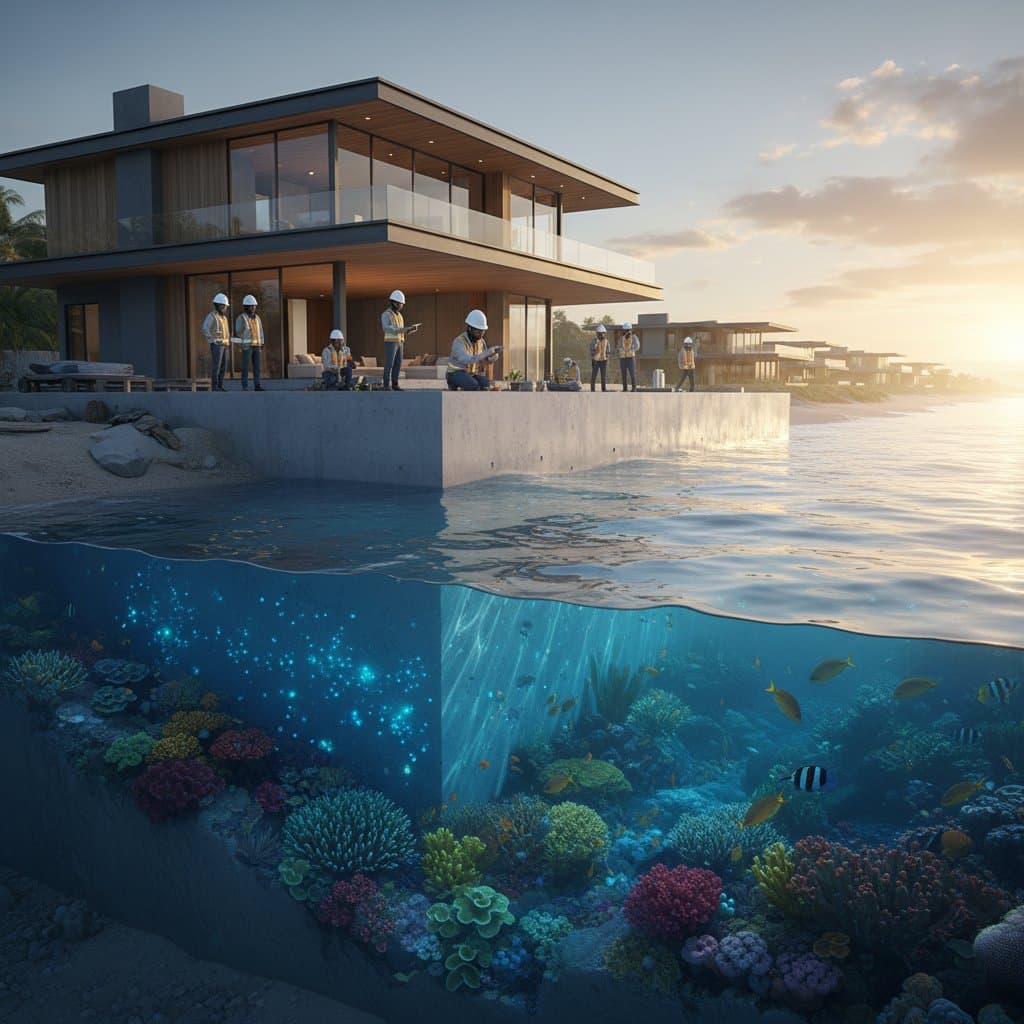
Why Coral-Safe Concrete Reshapes Coastal Foundations
Coastal piers withstand relentless exposure to saltwater, waves, and marine organisms. Traditional concrete forms the foundation of such structures, yet it imposes a significant environmental toll. Chemicals from conventional mixes leach into the water and harm coral reefs, which rank among the world's most vulnerable ecosystems. Coral-safe concrete emerges as an innovative alternative that preserves marine habitats while ensuring robust construction.
Consider the implications before exploring further.
Highlights
- Coral-safe concrete safeguards marine ecosystems without compromising structural integrity or longevity.
- Eco-friendly binders and additives prevent harm to coral and eliminate toxin release.
- Enhanced performance in saltwater settings lowers repair expenses over time.
- Builders and property owners access viable options for sustainable coastal foundations.
- The material promotes marine biodiversity instead of contributing to its decline.
What Is Coral-Safe Concrete?
Coral-safe concrete represents a tailored formulation intended to reduce environmental impact in marine and coastal projects. Developers substitute traditional Portland cement with low-carbon, non-toxic binders that avoid releasing lime or heavy metals into surrounding waters. These binders frequently incorporate recycled elements such as fly ash, slag, or natural pozzolans, which exhibit reduced reactivity with seawater.
Standard concrete disrupts water pH levels, triggering coral bleaching and mortality. In contrast, coral-safe concrete preserves chemical equilibrium, enabling adjacent reefs to flourish post-construction. This adjustment in material composition yields substantial ecological gains.
Photo: A diver examining a coral-compatible seawall adjacent to a coastal site.
Why Coastal Foundations Require Innovation
Coastal foundations face perpetual challenges from saltwater immersion, elevated humidity, and fluctuating temperatures. These factors gradually erode steel reinforcements and compromise concrete stability. Consequently, projects demand frequent interventions and inflict ecological harm.
Coral-safe concrete enables the development of enduring, corrosion-resistant installations that simultaneously benefit marine species. Its superior chemical composition minimizes fractures, decreases upkeep requirements, and maintains pristine shorelines.
The following table illustrates key distinctions between coral-safe and traditional concrete:
| Feature | Traditional Concrete | Coral-Safe Concrete |
|---|---|---|
| Binder | Portland cement | Low-carbon, non-toxic materials |
| Marine impact | Detrimental to coral | Compatible with ecosystems |
| Durability in saltwater | Moderate | Superior |
| Maintenance needs | Regular interventions | Minimal long-term |
| Eco footprint | Elevated CO2 emissions | Reduced emissions |
How Coral-Safe Concrete Functions
The effectiveness stems from its underlying chemistry. Conventional cement produces calcium hydroxide, elevating seawater pH. Coral-safe concrete circumvents this issue through binders that cure without such reactions. Certain variants integrate marine minerals to facilitate attachment and growth of coral larvae.
Key Ingredients
- Pozzolanic materials that yield compact concrete and restrict water ingress.
- Calcium silicate hydrates that sustain load-bearing capacity absent toxin emission.
- Recycled aggregates, including pulverized glass or shell particles, which harmonize with oceanic settings.
These components render coral-safe concrete both resilient and environmentally sound. It effectively counters chloride-induced corrosion, the primary deteriorative force in coastal bases.
Photo: Detailed view of coral-safe concrete units incorporating shell inclusions.
Benefits Extending Past Environmental Protection
Adopting coral-safe concrete transcends ecological considerations; it constitutes a prudent fiscal strategy. While upfront expenses exceed those of standard options, enduring cost reductions and habitat preservation justify the choice.
Environmental Advantages
- Facilitates coral reef restoration through stable water chemistry.
- Diminishes pollution associated with cement manufacturing.
- Fosters diverse marine life by providing suitable surfaces for organism settlement.
Economic and Structural Advantages
- Curbs maintenance expenditures via heightened resilience.
- Prolongs service life of elements like piers, seawalls, and foundational supports.
- Qualifies projects for fiscal incentives or sustainability accreditations.
Tip: For upcoming coastal endeavors, inquire with contractors regarding coral-safe concrete availability. Specialized procurement may apply, though regional providers in shoreline areas stock such formulations with growing frequency.
Practical Implementations
Professionals apply coral-safe concrete across diverse initiatives, spanning marinas and seawalls to shoreline-adjacent residential bases. Waterfront residents incorporate it into retaining walls and pool surrounds to lessen their ecological influence.
Envision a seaside residence constructed with substances that repel saltwater erosion and conserve the adjacent marine expanse. Coral-safe concrete realizes this vision for tomorrow's coastal landscapes.
Photo: Modern beachfront residence with coral-safe concrete retaining features.
Frequently Asked Questions on Coral-Safe Concrete
Does coral-safe concrete match the strength of conventional varieties?
It does, and frequently surpasses them in saline conditions. Greater density and refined binders enhance resistance to fractures and degradation.
Does coral-safe concrete incur higher expenses?
Upfront pricing ranges 10 to 20 percent above standard, yet diminished repair demands recoup the premium across the structure's duration.
Is coral-safe concrete suitable for home-based applications?
Yes. Property owners in coastal zones employ it for terraces, access paths, and bases, particularly under rigorous environmental codes.
In what ways does it aid reef rehabilitation?
Neutral pH preservation and absence of leaching avert harm. Select blends generate surfaces conducive to coral proliferation.
Advancing Sustainable Shorelines
Selecting coral-safe concrete stands as a pivotal method to establish eco-conscious foundations that uphold shoreline aesthetics. Homeowners undertaking renovations or developers managing expansive coastal ventures contribute to ocean conservation while bolstering project resilience.
Residences gain enhanced appeal when the surrounding seas remain vibrant. Coral-safe concrete fortifies bases and replenishes marine vitality, aligning human development with coastal ecosystems for mutual endurance.