
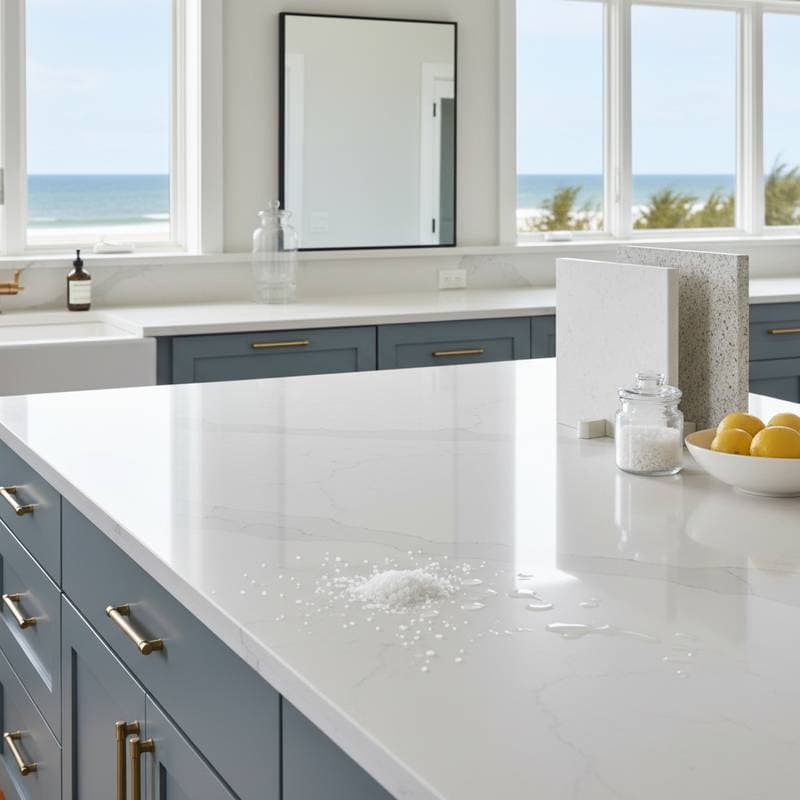
Why Quartz Countertops Excel in Salt Air Over Granite
Coastal living brings unique challenges to home materials, particularly in kitchens exposed to salt-laden air, high humidity, and frequent moisture. Homeowners in these environments often face the dilemma of selecting countertops that withstand corrosion while maintaining aesthetic appeal. Quartz emerges as a superior choice compared to granite, offering enhanced durability and reduced upkeep in salty conditions.
Key Advantages at a Glance
- Superior resistance to salt-induced corrosion
- Nonporous composition that blocks moisture and bacterial growth
- Simplified cleaning routines suited to high-traffic beach residences
- Uniform color options that complement seaside aesthetics
- Extended service life for optimal value over time
Understanding the Impact of Coastal Conditions on Countertops
Salt air accelerates material degradation through a process known as corrosion, where sodium chloride particles infiltrate surfaces and promote chemical reactions. Granite, prized for its organic patterns, contains microscopic pores that absorb these elements, leading to gradual erosion, pitting, and loss of luster. In contrast, quartz countertops consist of 90 to 95 percent ground natural quartz combined with polymer resins, forming a seamless, impermeable barrier.
This engineered design prevents salt penetration, preserving the countertop's integrity even in homes near breaking waves. Homeowners report that quartz surfaces remain unaltered after years of exposure, unlike granite, which may require professional restoration every few seasons.
Practical Advice: Inspect counters weekly for salt buildup by running a damp cloth over the surface; this simple habit extends the life of any material, though quartz demands minimal intervention.
Detailed Benefits of Quartz for Seaside Kitchens
Resistance to Salt and Humidity
The nonporous nature of quartz repels salt spray and humid air, eliminating the risk of internal damage. Granite demands annual or biannual sealing with penetrating sealers to fill its pores, a process that involves thorough cleaning, application, and curing time. Failure to seal promptly allows salt to etch the stone, creating permanent blemishes.
In coastal settings, where windows often remain open to capture breezes, quartz provides peace of mind without these recurring treatments.
Effortless Maintenance Protocols
Cleaning quartz requires only a soft cloth and a solution of warm water mixed with a pH-neutral dish soap. Avoid abrasive pads to prevent micro-scratches, though the material's hardness rating of seven on the Mohs scale ensures resilience against everyday wear. This low-effort approach suits families tracking in sand from the shore or preparing meals with briny ingredients.
Granite maintenance, by comparison, involves specialized stone cleaners and sealants, adding both time and expense to household routines.
Predictable Aesthetics and Design Versatility
Quartz manufacturers produce slabs with precise color matching, allowing seamless installations across large kitchen islands. Options include soft whites evoking sea foam, cool grays resembling driftwood, or subtle veining that echoes tidal patterns. This consistency simplifies design planning, especially when coordinating with cabinetry or flooring.
Granite's natural variability, while charming, can result in mismatched pieces during fabrication, potentially increasing costs for custom fits.
Robust Defense Against Stains and Scratches
Quartz withstands spills from lemon juice, red wine, or fish oils without absorbing them, thanks to its uniform resin binding. For optimal care, wipe spills immediately and use cutting boards to protect against knife marks. Granite, if unsealed, succumbs to acidic substances that etch its calcium-based composition, necessitating buffing or replacement in severe cases.
This durability proves invaluable during summer gatherings, where coastal entertaining often involves fresh seafood preparations.
| Feature | Quartz | Granite |
|---|---|---|
| Salt Resistance | Excellent | Moderate |
| Maintenance Needs | Minimal | Regular sealing required |
| Porosity | Nonporous | Porous |
| Color Consistency | High | Variable |
| Stain Resistance | Excellent | Moderate |
(Photo: A bright coastal kitchen featuring white quartz countertops and ocean-blue tile backsplash.)
Integrating Quartz into Coastal Interiors
Select quartz slabs that enhance natural light flow, such as those with minimal veining for a clean, airy vibe. Pair them with matte-finish hardware in brushed nickel to evoke a relaxed seaside retreat. Incorporate elements like linen curtains or shell-inspired hardware to amplify the tranquil atmosphere.
For variety, consider edge profiles like eased or bullnose, which soften the look without compromising strength. Consult fabricators experienced in coastal installations to ensure proper support under high-humidity conditions.
(Photo: Close-up of quartz countertop surface showing subtle veining and smooth texture.)
Securing Long-Term Performance in Your Coastal Residence
Quartz countertops adapt seamlessly to the rigors of salt air, delivering sustained elegance with straightforward care. This investment reduces long-term repair needs and enhances daily functionality in beachside living. Opt for quartz to create a kitchen that endures environmental demands while fostering memorable moments by the sea.