
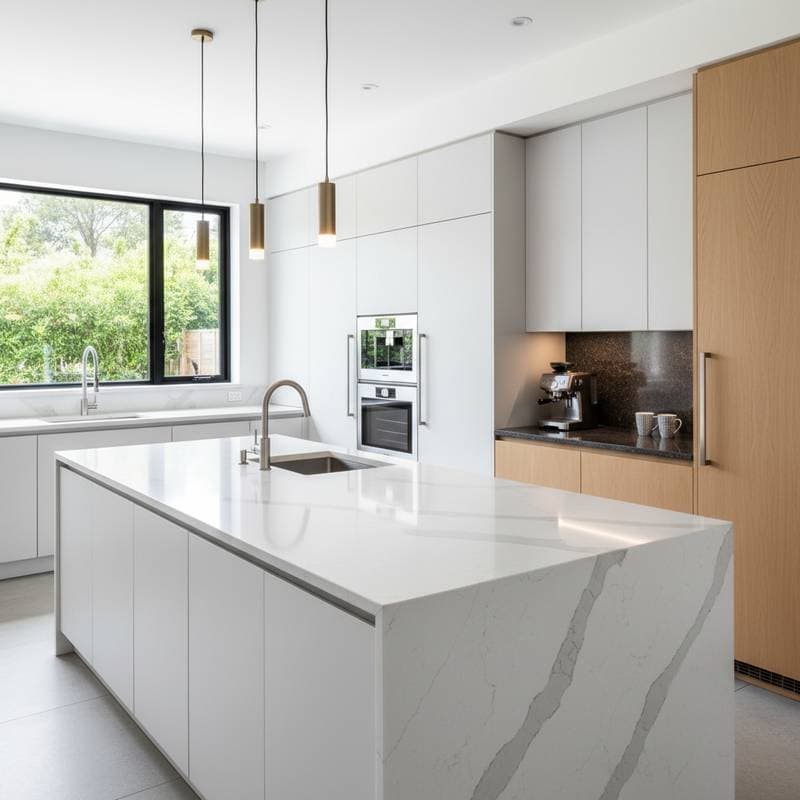
Quartz Surpasses Granite 3 to 1 in 2025 Kitchen Trends
Homeowners planning kitchen remodels observe a notable shift in countertop selections. Quartz now exceeds granite installations by a three-to-one margin. This trend stems from demands for enhanced durability, simplified maintenance, and uniform quality. Individuals updating their kitchens benefit from evaluating the reasons behind quartzs prominence to reach well-informed choices.
Average Costs of Quartz and Granite Countertops
Quartz and granite rank among the premier countertop options, yet they vary in pricing and enduring benefits. Installed quartz countertops typically range from 70 to 120 dollars per square foot. Granite installations average 60 to 100 dollars per square foot. Although quartz carries a modest premium initially, its reduced upkeep and broader design options compensate over time.
| Material | Average Cost per Square Foot Installed | Maintenance Level | Typical Lifespan | Appearance Consistency |
|---|---|---|---|---|
| Quartz | 70 to 120 dollars | Low | 25+ years | Very consistent |
| Granite | 60 to 100 dollars | Moderate | 20+ years | Natural variation |
Granite attracts with its authentic stone appearance, but quartz appeals through superior stain resistance, extensive color selections, and elimination of sealing needs. These attributes frequently surpass the minor initial cost disparity in the long run.
Reasons Quartz Leads in Contemporary Kitchens
Three primary elements account for quartzs prevalence in current kitchen renovations: superior performance, adaptable designs, and straightforward maintenance.
Superior Performance Beyond Natural Stone
Quartz consists of an engineered composite, comprising approximately 90 percent crushed stone blended with resins and pigments. This formulation renders it nonporous, providing robust defense against stains from wine, oil, or coffee compared to granite. As a porous material, granite demands routine sealing to avert staining and bacterial accumulation. Those seeking minimal-maintenance options value quartzs reliability and endurance.
Adaptable Designs and Contemporary Appeal
Quartz producers replicate natural stone, marble, or concrete appearances with precision. Options span hundreds of patterns and hues that ensure slab-wide uniformity. Granite offers beauty but exhibits significant variation across slabs. For seamless or minimalist kitchen visions, quartz delivers unparalleled consistency that complements the streamlined aesthetics of modern residences.
Straightforward Maintenance Ownership
Upkeep represents a pivotal choice for homeowners. Quartz demands no sealing, polishing, or specialized cleaners; a solution of mild soap and water suffices for pristine condition. Granite requires regular sealing and cautious cleaning to sustain its finish. In demanding households, quartzs ease provides substantial benefits.
Costs by Kitchen Dimensions and Project Extent
Expenses for countertops correspond to kitchen scale and renovation breadth. The following outlines average installed costs for quartz and granite based on kitchen size.
| Kitchen Size | Quartz Average Total Cost | Granite Average Total Cost |
|---|---|---|
| Small (40 sq. ft.) | 2,800 to 4,800 dollars | 2,400 to 4,000 dollars |
| Medium (60 sq. ft.) | 4,200 to 7,200 dollars | 3,600 to 6,000 dollars |
| Large (80 sq. ft.) | 5,600 to 9,600 dollars | 4,800 to 8,000 dollars |
Granite might seem more affordable per square foot, yet ongoing maintenance and sealing expenditures diminish this advantage. Across ten years, quartz frequently emerges as the superior financial choice.
Installation Labor and Influencing Variables
Labor constitutes 20 to 30 percent of overall countertop expenses, encompassing templating, fabrication, and fitting. Quartz slabs prove heavier and necessitate advanced cutting equipment, potentially elevating labor slightly over granite. Nevertheless, quartzs uniformity often streamlines the process, minimizing waste or alignment issues.
Variables Affecting Installation Expenses
- Intricate edge treatments extend fabrication duration.
- Openings for sinks or cooktops increment labor charges.
- Backsplash integrations elevate material and fitting totals.
- Slab thickness impacts material and structural support costs.
- Regional differences influence labor rates through local market dynamics.
Strategies to Reduce Quartz Countertop Expenses
Achieve quartzs aesthetic and functional advantages affordably through targeted approaches:
- Select conventional slab thickness. Two-centimeter options lower material outlays versus three-centimeter alternatives.
- Restrict edge complexity. Basic eased or beveled edges incur lower fees than elaborate designs.
- Incorporate remnants. Compact projects or islands utilize discounted leftover slabs.
- Solicit multiple estimates. Fabricator pricing fluctuates considerably.
- Combine services. During cabinet or flooring installations, inquire about bundled savings from contractors.
Thoughtful choices in the planning phase yield significant savings while preserving excellence.
Professional Installation Versus DIY Efforts
Some homeowners explore self-installation to lower costs, but quartz and granite resist amateur handling.
Necessity of Expert Involvement
Quartz slabs weigh over 20 pounds per square foot, demanding precise tools and expertise for cutting and placement. Errors risk destroying costly materials. Experts guarantee seamless joints, adequate support, and even surfaces, while managing transport and old material removal safely.
Feasible DIY Elements
Individuals with foundational carpentry knowledge may manage demolition, measurements, and backsplash tiling. Such contributions can trim labor expenses by 10 to 15 percent, avoiding risks to the new installation.
Pitfalls to Evade in Remodeling
Steering clear of frequent errors minimizes aggravation and financial loss.
- Neglecting expert measurements results in fabrication inaccuracies and added expenses.
- Selecting countertops prior to cabinets fosters compatibility challenges; establish cabinet configurations first.
- Failing to account for overhang or island support risks fractures.
- Disregarding illumination influences can distort perceived countertop hues in the environment.
- Disregarding market appeal may diminish investment recovery with excessive pattern selections.
Meticulous preparation and installer consultations avert these issues.
Frequently Asked Questions on Quartz Countertops
Do quartz countertops enhance home value?
Yes. As a high-end enhancement, quartz elevates kitchen attractiveness for prospective buyers. Homeowners recoup 60 to 80 percent of costs upon selling.
What is the durability of quartz countertops?
Proper maintenance extends quartz lifespan to 25 years or beyond. It withstands stains, scratches, and discoloration, preserving the initial appearance over decades.
Can quartz endure heat from cookware?
Quartz tolerates moderate heat yet risks scorching or cracking from intense sources. Employ trivets or pads to shield against direct hot item contact.
Is sealing required for quartz countertops?
No. Its nonporous nature eliminates sealing or coatings, simplifying care relative to granite or marble.
Exist sustainable quartz varieties?
Yes. Numerous producers integrate recycled content and environmentally sound processes. Opting for regional fabrication lessens ecological impact.
Can quartz imitate other substances?
Certainly. It emulates marble, concrete, or rare granites, combining aesthetic mimicry with enhanced strength and consistency.
Optimal cleaning method for quartz countertops?
Apply mild dish soap and water. Steer clear of abrasive tools or bleach-based products; a soft cloth or sponge suits routine care.
Steps to Implement Your Kitchen Upgrade
Quartzs ascendancy in kitchen preferences mirrors enduring homeowner values: enduring beauty, impeccable function, and effortless care.
Commence your remodel by touring nearby showrooms to examine quartz samples firsthand. Carry cabinet and flooring swatches for optimal coordination. Secure itemized proposals delineating material, fabrication, and installation fees.