
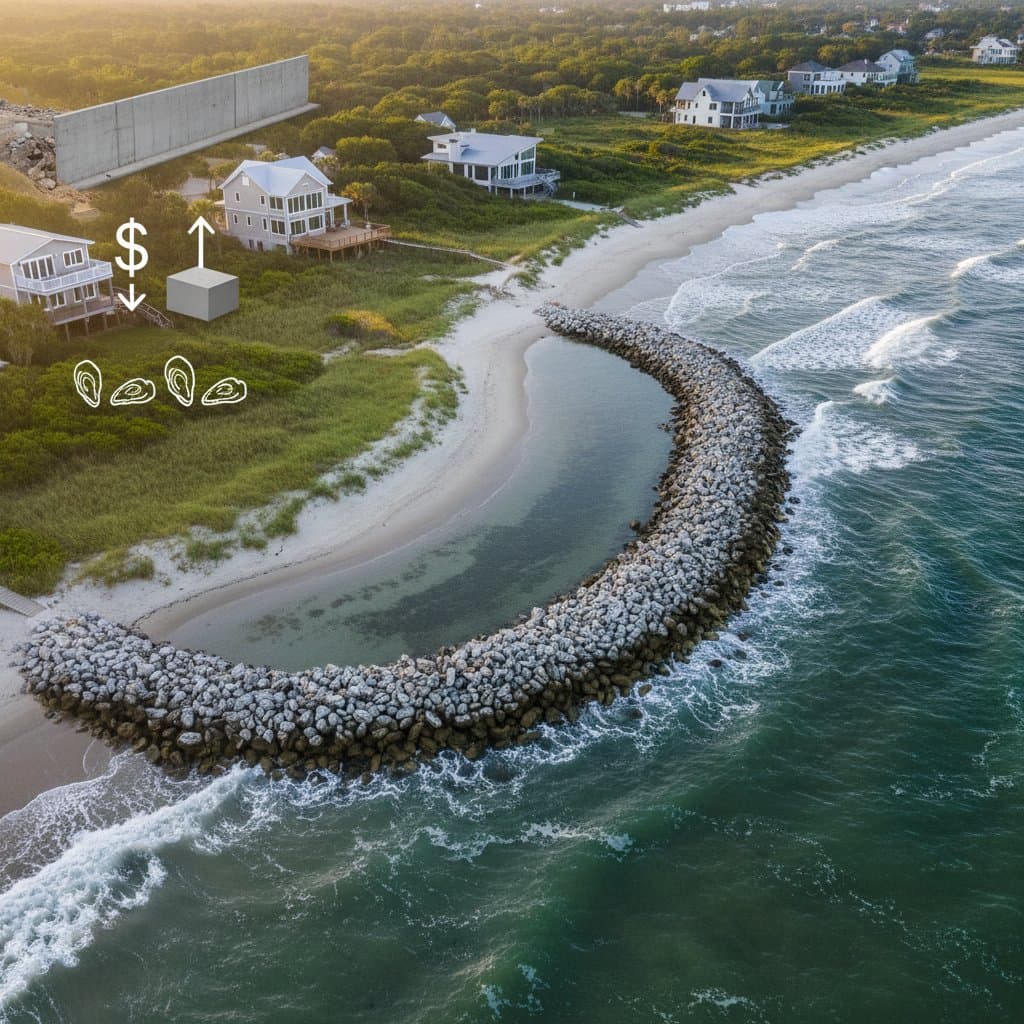
Oyster Reefs: A Natural Alternative to Concrete Coastal Barriers
Coastal erosion poses ongoing risks to waterfront areas. Higher sea levels and intensified storms erode beaches and shorelines, prompting property owners and local governments to seek reliable safeguards. For years, concrete seawalls and rock breakwaters have served as primary defenses, yet they carry substantial environmental and economic burdens. Oyster reefs now emerge as a viable, eco-conscious option that matches or exceeds the effectiveness of these conventional methods.
Oyster reefs function as dynamic coastal shields. They secure shorelines, lessen wave force, and promote diverse marine habitats. Unlike rigid structures, these reefs regenerate naturally, delivering enduring protection while bolstering local ecology.
Installation Costs for Oyster Reefs
Installation expenses for oyster reefs depend on project scale, configuration, and resources. Restoration efforts typically run from 50 to 250 dollars per linear foot. In comparison, concrete seawalls demand 400 to 1,200 dollars per linear foot.
Community initiatives with volunteer support and reused shells often fall below 50 dollars per foot. Engineered setups for urban coastlines may reach the upper limit, yet they prove more economical overall than concrete alternatives.
| Barrier Type | Average Cost per Linear Foot | Typical Lifespan | Maintenance Cost | Environmental Benefit |
|---|---|---|---|---|
| Concrete Seawall | 400 - 1,200 | 25 - 40 years | High | Low |
| Rock Breakwater | 200 - 600 | 30 - 50 years | Moderate | Moderate |
| Oyster Reef | 50 - 250 | Self-sustaining | Low | High |
Oyster reefs expand organically as larvae attach to shells, enhancing durability without added expense. This self-repair mechanism balances upfront investments and ensures sustained performance.
Costs Based on Project Scale
The overall budget hinges on the project's dimensions.
- Small residential efforts under 100 linear feet: 5,000 to 20,000 dollars.
- Community-scale projects from 100 to 500 linear feet: 20,000 to 125,000 dollars.
- Extensive municipal undertakings over 500 linear feet: 125,000 dollars or higher.
These figures account for design intricacies, approvals, and supply logistics. Residential reefs frequently employ modular blocks or shell-filled mesh bags. Broader installations incorporate custom modules tailored to local water dynamics.
Material Options and Their Costs
Selecting materials influences expenses and ecological outcomes.
| Material Type | Description | Cost per Linear Foot | Durability | Ecological Benefit |
|---|---|---|---|---|
| Recycled Oyster Shell | Crushed or intact shells from eateries or farms | 50 - 100 | Moderate | Excellent |
| Concrete Reef Modules | Factory-made units for oyster adhesion | 100 - 250 | High | Good |
| Limestone or Granite | Rock foundations for oyster growth | 80 - 200 | High | Moderate |
| Biodegradable Mesh Bags | Shell- or gravel-filled bags for shallow zones | 40 - 90 | Moderate | High |
Sourcing recycled shells from nearby sources maximizes affordability and sustainability. Concrete modules suit demanding sites needing exact specifications.
Labor and Additional Expenses
Labor accounts for 20 to 40 percent of the total. Experienced marine specialists charge 60 to 120 dollars hourly, scaled to task demands. Community involvement or volunteer programs lower these figures significantly.
Permits, assessments, and surveys contribute another 10 to 15 percent. Oyster projects frequently access grants from environmental organizations, easing financial pressures absent in concrete builds.
Key Factors Affecting Project Costs
Multiple elements shape the final expenditure:
- Site-specific tidal patterns and exposure.
- Depth of water and intensity of waves.
- Equipment accessibility during setup.
- Existing seabed composition, such as sand or sediment.
- Local supply of oyster shells.
- Regulatory hurdles and approvals.
- Level of community or volunteer participation.
Strategic planning and collaboration with authorities streamline processes and trim budgets.
Oyster Reefs Versus Concrete Barriers
Concrete seawalls offer instant fortification but bounce back waves, undermining foundations and nearby shores. Oyster reefs absorb energy progressively, capturing sediments to fortify the coast.
| Feature | Concrete Seawall | Oyster Reef |
|---|---|---|
| Wave Reduction | 30 - 50 percent | Up to 80 percent |
| Shoreline Erosion | Frequently intensifies | Markedly decreases |
| Habitat Creation | None | Supports fish and shellfish |
| Maintenance | Demands ongoing fixes | Naturally maintains itself |
| Aesthetic Value | Harsh, man-made look | Blends seamlessly with nature |
Beyond erosion control, oyster reefs purify water; each mature oyster processes 50 gallons daily, fostering cleaner bays and estuaries.
Strategies to Reduce Oyster Reef Expenses
- Source shells from regional seafood operations to minimize material outlays.
- Collaborate with nonprofits for labor and financial aid.
- Opt for expandable modular setups to phase in growth.
- Rely on natural oyster spawning to populate structures without extra seeding.
- Integrate with vegetation like salt marshes for comprehensive protection.
Homeowner Options: DIY or Professional Services
Property owners with accessible, low-wave shorelines can handle modest reefs using basic equipment at low tide. Bagged shell placements provide straightforward entry points.
Complex designs demand experts for accuracy, simulations, and regulatory adherence. Professionals guarantee resilience against harsh conditions.
| Task | DIY Feasibility | Professional Required |
|---|---|---|
| Gathering and preparing shells | Yes | No |
| Packing mesh bags | Yes | No |
| Installing shallow reefs | Yes | Optional |
| Engineering reef layouts | No | Yes |
| Securing permits | No | Yes |
| Deep-water deployments | No | Yes |
Pitfalls to Sidestep in Oyster Reef Projects
- Skipping thorough site evaluations, which risks instability.
- Selecting mismatched materials that damage wildlife.
- Constructing excessively large reefs that alter currents.
- Bypassing approvals, inviting penalties and dismantling.
- Overlooking routine checks to confirm reef health and expansion.
Essential Questions on Oyster Reefs
Can oyster reefs effectively halt erosion?
Yes, they diminish wave power by as much as 80 percent, enabling sediment buildup for firmer shores.
Is a permit necessary for an oyster reef?
Permits are standard for tidal installations. Consult coastal authorities early to meet all standards.
How much time passes before a reef fully establishes?
Structures offer prompt shielding, with peak development occurring over multiple growth cycles as oysters multiply.
What upkeep do oyster reefs need?
Minimal intervention suffices; periodic inspections track growth and remove debris. Natural processes handle most repairs.
Advancing Coastal Resilience with Oyster Reefs
Implementing oyster reefs transforms shoreline management. These structures not only slash costs by up to 75 percent compared to concrete but also revive ecosystems and enhance community well-being. By embracing this approach, coastal regions secure a resilient future that harmonizes human needs with environmental health.