
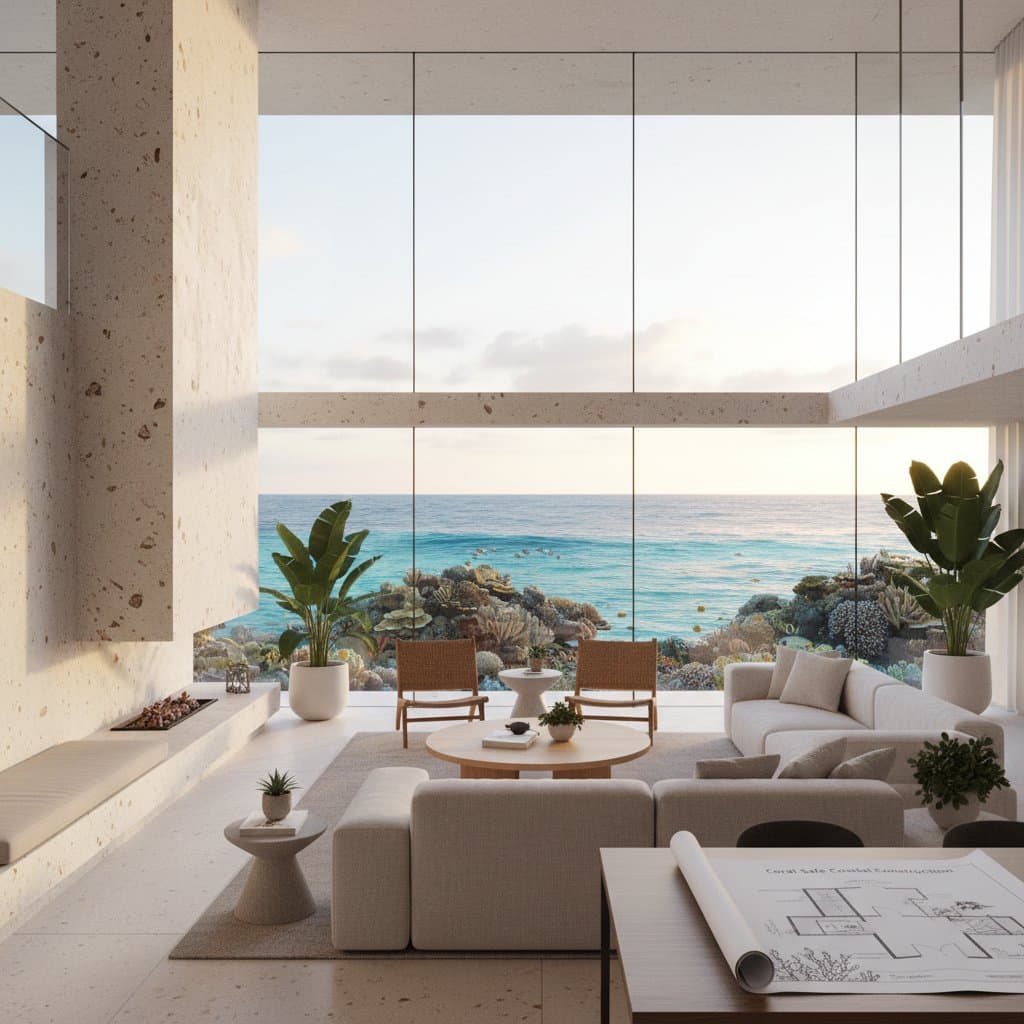
New Coral-Safe Concrete Standard for Coastal Homes
Coastal homeowners often balance structural durability against the need to safeguard nearby marine ecosystems. Traditional concrete releases alkaline compounds that leach into seawater and damage coral reefs. A new coral-safe concrete standard addresses this issue by specifying low-alkalinity mixes and sustainable materials that limit chemical runoff while maintaining strength. This guide covers the composition of coral-safe concrete, its performance characteristics, project costs, and practical steps for incorporating it into coastal builds.
Definition and Composition
Coral-safe concrete replaces a portion of Portland cement with supplementary cementitious materials such as fly ash, slag, or natural pozzolans. These additives lower the pH of the mix and reduce the release of calcium hydroxide into surrounding water. The standard also restricts curing methods and surface finishes within designated coastal zones to prevent harm to reefs and other marine life.
Cost Overview
Coral-safe concrete typically costs between 140 and 185 dollars per cubic yard, while standard concrete ranges from 120 to 150 dollars per cubic yard. The 10 to 25 percent premium is often recovered through lower maintenance needs and longer service life in saltwater environments.
| Concrete Type | Cost per Cubic Yard | Leaching Risk | Saltwater Durability |
|---|---|---|---|
| Standard | 120 to 150 dollars | High | Moderate |
| Coral-Safe | 140 to 185 dollars | Minimal | High |
| Marine-Grade | 160 to 210 dollars | Low | Very High |
Project Cost Examples
Foundation replacements for typical coastal homes require 80 to 120 cubic yards and range from 11,200 to 21,600 dollars. Driveways and patios use 15 to 30 cubic yards at a total of 2,175 to 5,250 dollars. Seawalls and retaining walls fall between 3,000 and 7,400 dollars for 20 to 40 cubic yards.
Labor and Installation Factors
Labor usually represents 30 to 50 percent of total project expense. Coastal contractors charge 55 to 85 dollars per hour. Site preparation accounts for 10 to 15 percent of labor time, formwork and reinforcement take 25 to 30 percent, and mixing through finishing consumes 40 to 45 percent. A 1,000-square-foot foundation may require 80 to 100 labor hours for a finished cost of 15,000 to 20,000 dollars.
Core Requirements of the Standard
The standard rests on four technical controls. Low-alkalinity designs substitute cement with ground granulated blast furnace slag or volcanic ash. Non-metallic reinforcement such as fiber-reinforced polymers prevents corrosion. Controlled permeability additives reduce chloride intrusion. Regulated surface finishes limit pore exposure to seawater.
Variables Affecting Final Price
Proximity within 500 feet of the shoreline often requires additional coatings. Sloped or restricted sites increase equipment and labor time. Non-metallic reinforcement raises material costs. Controlled curing systems add expense. Environmental permits range from 300 to 1,000 dollars. Larger pours lower the unit price through volume discounts.
Material Comparisons
| Material | Cost per Square Foot | Expected Lifespan | Environmental Rating | Maintenance Level |
|---|---|---|---|---|
| Standard Concrete | 6 to 10 dollars | 50 years | Low | Moderate |
| Coral-Safe Concrete | 7 to 12 dollars | 60 years | High | Low |
| Recycled Aggregate Concrete | 8 to 13 dollars | 55 years | High | Moderate |
| Geopolymer Concrete | 9 to 14 dollars | 70 years | Very High | Low |
Geopolymer options deliver strong sustainability metrics yet remain less widely available. Coral-safe concrete balances performance, cost, and accessibility for most coastal applications.
Cost-Control Strategies
Order materials from nearby suppliers to limit transport expenses. Use partial supplementary cementitious material substitution where local rules permit. Combine multiple small pours into single sessions. Select sealed finishes that resist salt intrusion. Schedule work during stable weather periods. Reuse formwork across phases.
Professional Installation versus Owner Work
Small garden slabs or decorative elements can be handled by experienced owners who follow precise mix ratios. Structural elements such as foundations and seawalls require certified contractors who supply tested designs, code compliance, and equipment access. Professional work includes documented curing procedures and structural certification.
Errors That Reduce Performance
Avoid standard concrete near saltwater, which corrodes rapidly and may breach environmental rules. Seal all surfaces to block moisture absorption. Observe full cure times before loading. Grade sites to prevent standing water. Verify contractor experience with coastal eco-friendly projects before signing agreements.
Questions for Prospective Contractors
Confirm certification in coral-safe installation. Request the exact mix design and supporting test data. Ask about post-cure pH and permeability verification. Inquire how runoff is managed during mixing. Discuss reinforcement choices suited to marine exposure. Request references from prior coastal jobs. Review warranty terms and follow-up procedures.
Practical Questions Answered
Properties several blocks inland still benefit because groundwater can carry leachate from conventional concrete into marine zones. Properly installed coral-safe concrete routinely achieves 60-year service lives. Appearance matches standard concrete and accepts the same stains or polishes. Supplementary materials often produce denser matrices that resist thermal cracking and chloride penetration. The material suits driveways, patios, and structural work alike. Most coastal jurisdictions require compliance documentation rather than separate permits. Maximum value arises when eco-safe concrete is paired with elevated slabs, effective drainage, and sealed surfaces.
Protecting Long-Term Performance
Schedule annual inspections of sealed surfaces and drainage paths. Reapply sealers according to manufacturer intervals. Address minor cracks promptly to maintain the low-leaching characteristics that protect nearby reefs.