
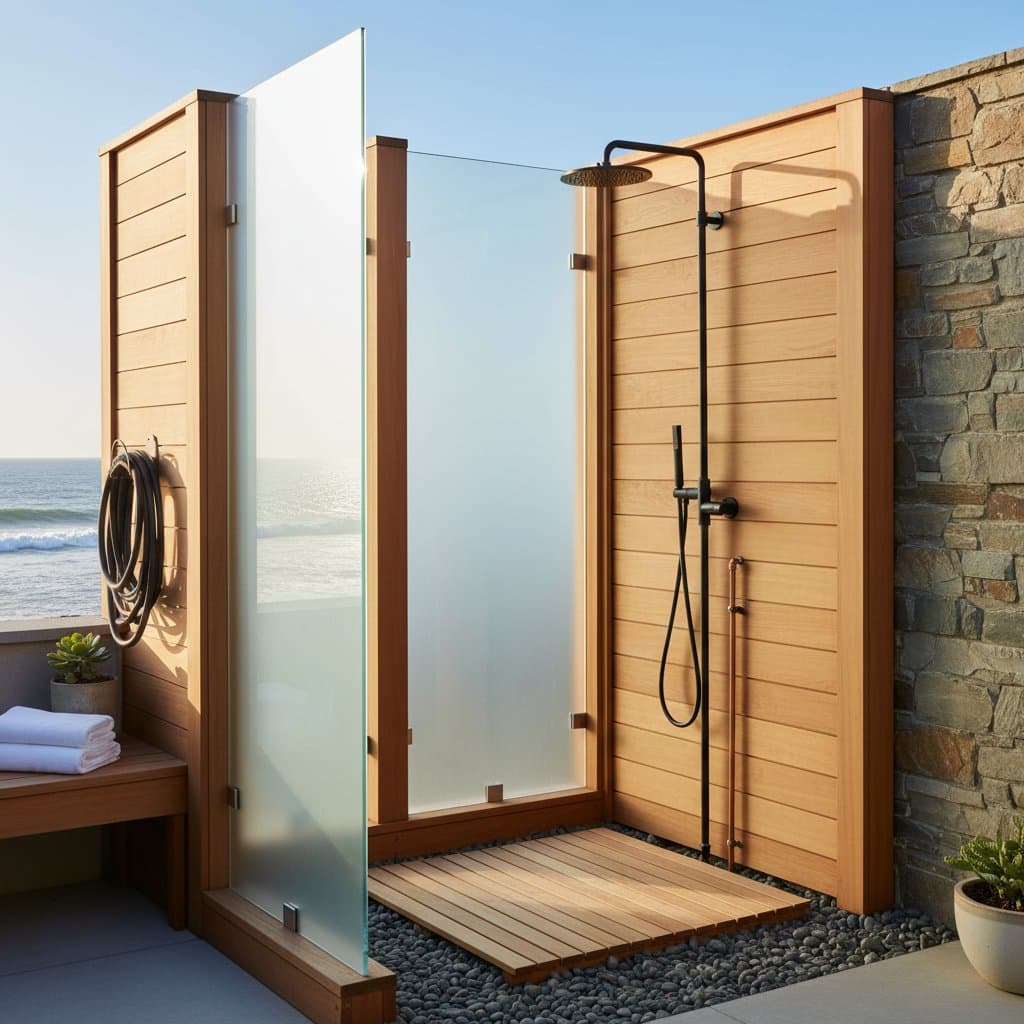
Understanding Outdoor Shower Costs
Outdoor showers offer a refreshing way to enhance coastal living, blending functionality with relaxation. Costs for these installations typically range from $3,000 to $12,000, influenced by multiple elements that determine both initial investment and long-term value. This guide explores nine critical factors that affect pricing, providing insights to help readers make informed decisions for their projects.
Factors such as materials and labor play significant roles, while site-specific considerations add layers of complexity. By examining these elements, individuals can develop a realistic budget and prioritize features that align with their lifestyle. The following sections detail each factor, offering practical advice for optimization.
The Nine Key Factors Influencing Costs
1. Materials Selection
The choice of materials forms the foundation of any outdoor shower, directly impacting durability and aesthetics. Options range from basic fiberglass enclosures at around $500 to premium teak or stone surrounds exceeding $2,000. Corrosion-resistant materials prove essential in coastal environments to withstand salt air and moisture.
Selecting weatherproof fixtures, such as stainless steel faucets, adds $200 to $800 but ensures longevity. Readers should weigh initial costs against maintenance savings when choosing between budget-friendly composites and high-end natural stones.
2. Plumbing Complexity
Plumbing requirements vary based on whether the shower connects to existing indoor lines or demands new infrastructure. Simple tie-ins to nearby water sources cost $1,000 to $2,000, while extending lines from the main house can reach $4,000 or more. Distance from the home and terrain challenges increase labor and material needs.
Hot water integration, including heaters or recirculation systems, adds $500 to $1,500. Consulting a plumber early helps identify potential obstacles, such as underground utilities, to avoid unexpected expenses.
3. Drainage Solutions
Effective drainage prevents water pooling and structural damage, with costs ranging from $300 for gravel trenches to $1,500 for custom French drains or permeable pavers. Site slope and soil type dictate the approach; clay-heavy soils may require advanced systems to manage runoff.
Integrating eco-friendly options like rain gardens can elevate costs by $800 but supports sustainable design. Proper planning ensures compliance with local codes, safeguarding the investment over time.
4. Design and Size
Larger or custom designs expand the footprint and price tag, with basic 4x4-foot units starting at $2,000 and elaborate 8x10-foot enclosures surpassing $6,000. Incorporating multiple heads or built-in benches increases complexity and expense.
Modular kits offer affordability at $1,500 to $3,000, while bespoke layouts demand higher fabrication fees. Readers benefit from sketching initial concepts to balance ambition with budget constraints.
5. Location on the Property
Site selection influences accessibility and preparation costs; installing near the house minimizes plumbing runs at $500 to $1,000, whereas remote beachfront spots add $2,000 for trenching and stabilization. Uneven terrain requires grading, which can cost $1,000 per 100 square feet.
Proximity to views enhances appeal but may involve environmental assessments adding $300 to $700. Evaluating multiple sites allows for cost-effective placement without compromising enjoyment.
6. Privacy Features
Enhancing seclusion through fencing or screens ranges from $400 for basic lattice to $2,500 for solid walls or living hedges. Tropical plants provide natural barriers at $200 to $800, while automated enclosures with doors elevate prices to $1,500.
These additions not only boost comfort but also increase property value. Prioritizing privacy aligns with personal needs, ensuring the space feels inviting and secure.
7. Professional Labor
Hiring skilled contractors accounts for 30 to 50 percent of total costs, with rates from $50 to $150 per hour depending on region and expertise. A standard installation takes 2 to 5 days, totaling $2,000 to $5,000 in labor.
Coordinating multiple trades, such as plumbers and masons, streamlines the process but requires careful scheduling. Obtaining multiple quotes ensures competitive pricing without sacrificing quality.
8. Permits and Regulations
Local building permits cost $100 to $500, with additional fees for environmental reviews in coastal zones reaching $1,000. Compliance with zoning laws and setback requirements may necessitate design adjustments.
Professional assistance in navigating bureaucracy saves time and avoids fines. Early research into regulations prevents delays that inflate overall expenses.
9. Fixtures and Accessories
Beyond basics, accessories like rainfall heads, thermostatic valves, or storage shelves add $300 to $1,200. Lighting for evening use, including solar options, ranges from $150 to $600.
Smart features, such as app-controlled temperatures, introduce $400 to $800 but enhance usability. Selecting energy-efficient elements reduces operational costs over the shower's lifespan.
Strategies for Effective Budgeting
Developing a budget begins with listing priorities, such as essential plumbing versus optional luxuries. Allocating 10 to 15 percent for contingencies covers unforeseen issues like soil surprises. Comparing vendor quotes and material samples fosters transparency in spending.
Phased installations allow starting with core elements and adding features later, spreading costs over time. Tracking expenses through spreadsheets maintains control and highlights savings opportunities.
Achieving a Balanced Coastal Retreat
Integrating these factors leads to an outdoor shower that complements the home's architecture and enhances daily routines. Thoughtful planning yields a space that delivers years of enjoyment with minimal upkeep. Readers equipped with this knowledge can confidently pursue a project tailored to their vision and resources.