
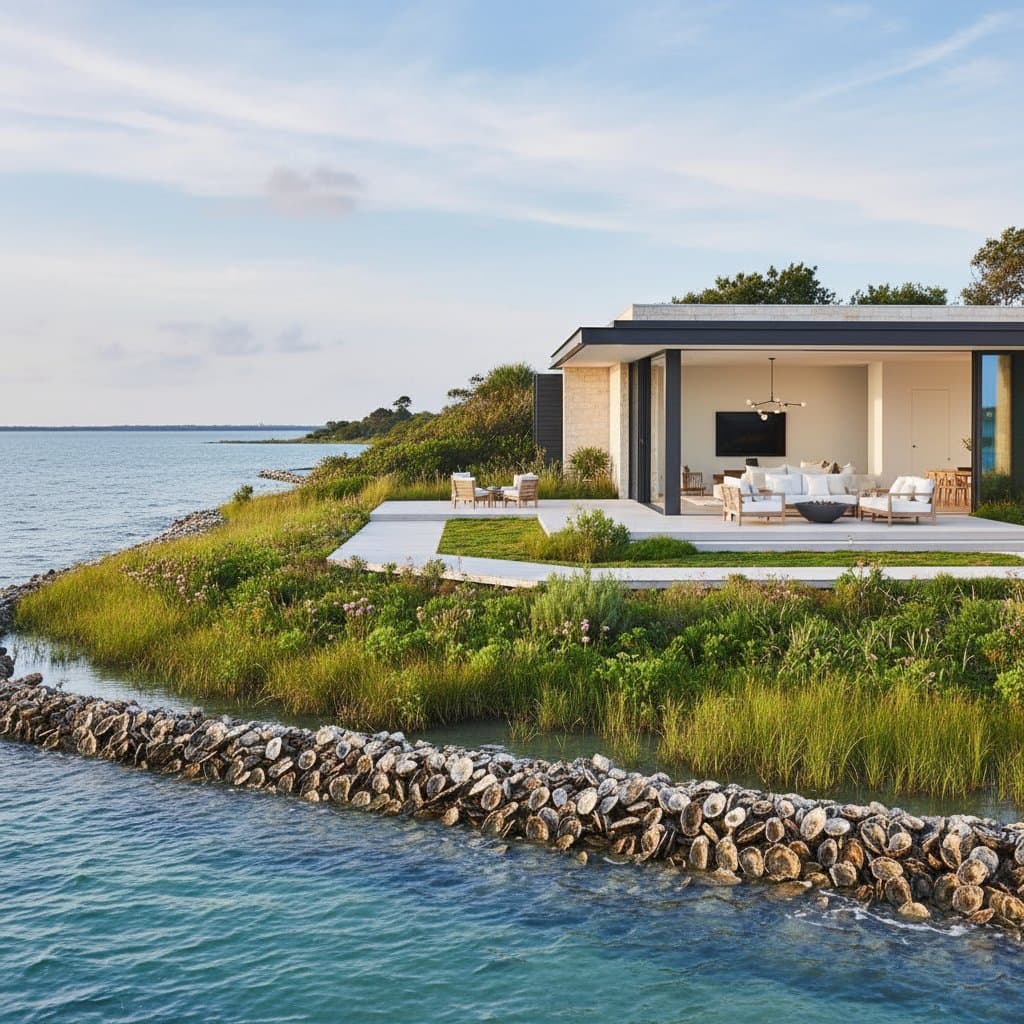
Long-term evaluation reveals that living shorelines endure for decades with limited intervention, whereas seawalls fracture or fail, leading to costly repercussions.
Types and Options
Vegetated Buffers
Vegetated buffers employ native grasses, shrubs, and dune flora to secure soil and dissipate wave impact. They suit mild gradients and low-impact shorelines, fostering habitats for avian, insect, and aquatic species.
Ideal for: Property owners with expansive beaches or subtle inclines.
Advantages: Enhances biological diversity, purifies stormwater, and adjusts to tidal variations.
Drawbacks: Performs less optimally in intense wave environments absent supplementary support.
Photo: Justin Paget / Getty Images
Oyster Reefs
Oyster reefs function as organic breakwaters, moderating waves, capturing sediment, and nurturing fish and shellfish populations. In locales with appropriate salinity and water conditions, these reefs strengthen naturally.
Ideal for: Bays, estuaries, and intertidal zones featuring moderate salinity levels.
Advantages: Self-perpetuating, clarifies water, and bolsters regional ecology.
Drawbacks: Demands precise positioning and ecological oversight.
Photo: Scott Eells / Getty Images
Hybrid Systems
Hybrid configurations merge indigenous vegetation with modest rock sills or eco-friendly barriers. The framework mitigates wave force as plants consolidate the soil in its wake.
Ideal for: Regions exposed to robust surf or vessel-generated wakes.
Advantages: Harmonizes robustness and adaptability, fitting for private and collective initiatives.
Drawbacks: Entails elevated initial expenditure relative to pure vegetative methods.
Photo: Catherine Lane / Getty Images
Dune Restoration
Dune restoration entails reforming sand elevations and introducing species like beachgrass or saltbush. These formations serve as innate shields, absorbing wave energy and averting inland inundation.
Ideal for: Exposed sandy beaches subject to wind-induced erosion.
Advantages: Delivers a seamless natural look, demands straightforward care, and aids indigenous fauna.
Drawbacks: Necessitates ample area and consistent botanical oversight.
Photo: Tom Merton / Getty Images
DIY Versus Professional Installation
For individuals inclined toward practical endeavors on gentle slopes, a modest living shoreline project might suit a weekend effort. Planting native species, positioning biodegradable fiber rolls, and observing development require elementary implements. Budget $1,000 to $3,000 for supplies on a compact home site.
Suitable DIY scenarios encompass:
- Zones with minimal wave activity
- Easily reachable shorelines
- Owners committed to routine vegetation care
On substantial or dynamic sites, engage professionals. Coastal engineers and restoration experts devise balanced ecological and secure designs. They manage assessments, regulatory coordination, and procurement. Such endeavors span one to three weeks, contingent on scale and climate.
Professional involvement incurs higher preliminary costs but guarantees adherence to coastal mandates and sustained robustness.
Key Considerations
Prior to initiating vegetation or construction, assess these aspects:
- Wave exposure levels: Mild conditions support plant-based solutions; forceful waves benefit from hybrids.
- Tidal fluctuations: Select tolerant species for intermittent submersion.
- Soil composition: Sandy substrates drain swiftly, whereas clay-rich ones may require mitigation.
- Regulatory frameworks: Consult coastal commissions or municipal planners prior to modifications. Approvals safeguard owners and aquatic environments.
- Adjacent properties: Alterations influence neighboring erosion; cooperative efforts enhance zonal stability.
Systematic review guides material and technique selection for enduring results.
Strategies to Reduce Expenses
Living shorelines inherently economize over time, with targeted tactics further lowering setup costs:
- Source local resources. Procuring nearby native plants and stones minimizes shipping fees.
- Participate in communal efforts. Collective restoration initiatives distribute labor burdens.
- Implement phased approaches. Commence with plantings, incorporating structures subsequently.
- Pursue funding opportunities. Coastal preservation grants frequently back such ventures.
- Perform routine upkeep personally. Debris clearance and health checks limit expert engagements.
These measures can decrease outlays by 10 to 30 percent while preserving efficacy.
Maintenance and Durability
Distinct from seawalls prone to fracturing or subsidence, living shorelines fortify progressively. Expanding root systems, densifying oyster formations, and sediment accumulation occur organically. Upkeep entails periodic reviews and selective replanting.
Standard activities comprise:
- Substituting storm-affected vegetation
- Eliminating non-native intruders
- Inspecting barriers or sills for shifts
- Clearing accumulations to avoid stagnation
Most owners manage these with basic equipment over a few seasonal hours. Gradually, the biosphere equilibrates, diminishing necessary actions.
Environmental and Community Advantages
Exceeding erosion mitigation, living shorelines yield tangible ecological gains. They cleanse pollutants, enhance aquatic visibility, and supply vital refuges for fisheries and avifauna. Moreover, these installations elevate site esthetics, converting defenses into lush domains.
Broader communities gain through accessible pathways, instructional initiatives, and participatory events that cultivate responsibility. Buffers lessen inundation threats to vicinities, positioning living shorelines as communal assets for resilience.
Seawalls redirect energy seabed-ward, eroding sands and imperiling biota. They may hasten adjacent degradation. Transitioning to living alternatives reframes the approach from opposition to harmony with natural processes.
Navigating Regulations
Numerous coastal bodies promote or mandate gentler stabilization methods. Approval entities scrutinize ecological effects, accessibility, and habitat integrity. Living shorelines expedite reviews by aligning with sustainability objectives.
Owners may access rebates or waived fees for natural selections. Requirements differ regionally; verify stipulations promptly. Consultants assist with paperwork and conformity.
Steps to Implement
Establishing a living shoreline transcends mere safeguarding; it reinstates equilibrium between habitation and oceanic cadence. Every marsh planting or secured shell integrates into an adaptive, resilient network.
Coastal preservation commences individually. For private beaches or shared fronts, opting for living over rigid barriers preserves cherished terrains and reliant biodiversity.